Is your store leaking revenue?
Find out exactly where you're losing sales — takes 2 minutes.
The math that separates stores that scale from stores that bleed
What Is a Break-Even Analysis?
Every store has a number.
A break-even analysis is a financial calculation that determines the exact point where total revenue equals total costs — zero profit, zero loss. For ecommerce, this means dividing fixed costs by contribution margin per unit (or ratio). According to Harvard Business School, 82% of small businesses fail due to cash flow problems, and break-even analysis is the first defense against that failure.
That number is your break-even point. Below it, every order you fulfil costs you money. Above it, every order generates profit. There is no middle ground.
We run the break even calculation for every Shopify store we audit. The result shocks most founders. They assumed they were profitable at 50 orders a month. The math showed they needed 120. Or they thought they needed RM 30,000 in monthly revenue to cover costs. The real number was RM 48,000.
The gap between perception and reality is where stores die quietly.
Here is how to do the calculation yourself — in units, in revenue, and for multiple products. No accounting background needed.
Why Does Break-Even Analysis Matter for Ecommerce?
Most founders skip it.
Break-even analysis matters because it prevents the most common ecommerce failure mode: growing revenue while losing money on every order. A CB Insights study found that 38% of startups fail because they run out of cash — and most of them had increasing revenue when they died. The break even calculation exposes this trap before it kills you.
Revenue growth feels good. It looks good on dashboards. But revenue without margin awareness is a trap. You sell more, spend more on ads, order more inventory — and the bank account shrinks.
Break-even analysis forces you to answer three questions before spending another ringgit:
- How many units do I need to sell each month to cover all costs?
- How much revenue does that represent?
- Is that number realistic given my traffic, conversion rate, and AOV?
If the answer to question three is no, you have two options: cut costs or raise prices. Both are better than finding out six months later.
When to Run a Break-Even Analysis
- Before launching a new product or SKU
- Before increasing ad spend
- Before offering a discount or promotion
- Before hiring staff or adding a subscription tool
- After any change to COGS, shipping rates, or payment processing fees
- Quarterly, as a financial health check
Any time your costs or prices change, the break-even point moves. Treat it as a living number, not a one-time exercise.
How Do You Calculate the Break-Even Point?
Two inputs. One division.
The break-even point in units equals Fixed Costs divided by Contribution Margin Per Unit. In revenue, it equals Fixed Costs divided by Contribution Margin Ratio. These formulas come from standard managerial accounting and are used by every CFO, media buyer, and serious Shopify operator to set minimum performance thresholds. Investopedia's break-even framework confirms this approach.
Before you run the formula, you need three numbers.
Step 1: List Your Fixed Costs
Fixed costs are expenses that do not change with sales volume. They hit your bank account whether you sell one unit or ten thousand.
| Fixed Cost | Typical Range (Monthly) |
|---|---|
| Shopify subscription | RM 150 – RM 1,500 |
| Warehouse / storage rent | RM 1,000 – RM 5,000 |
| Staff salaries | RM 3,000 – RM 15,000 |
| Software tools (Klaviyo, apps) | RM 500 – RM 3,000 |
| Insurance | RM 200 – RM 800 |
| Accounting / bookkeeping | RM 500 – RM 2,000 |
Add yours up. This is your total monthly fixed cost. For this example, we will use RM 12,000/month.
Step 2: Calculate Variable Cost Per Unit
Variable costs scale with each sale. If you do not sell the unit, you do not incur the cost.
- COGS — materials, manufacturing, wholesale price
- Shipping and fulfillment — courier fees, 3PL pick-and-pack
- Payment processing — typically 2.5-3.5% of the selling price
- Packaging — boxes, inserts, branded tissue
- Marketplace commissions — if selling on Lazada, Shopee, etc.
Step 3: Run the Formula
Break-Even in Units:
Break-Even Units = Fixed Costs / (Selling Price – Variable Cost Per Unit)
The denominator — selling price minus variable cost — is your contribution margin per unit. It is the money each sale leaves behind to cover fixed costs.
Break-Even in Revenue (Dollars/Ringgit):
Break-Even Revenue = Fixed Costs / Contribution Margin Ratio
The contribution margin ratio is contribution margin per unit divided by selling price, expressed as a percentage. Use the contribution margin calculator to get this instantly.

What Does a Real Break-Even Calculation Look Like?
Numbers make it concrete.
A Shopify skincare brand selling a RM 160 serum with RM 58 in variable costs has a contribution margin of RM 102 per unit. With RM 12,000 in monthly fixed costs, the break-even point is 118 units or RM 18,824 in revenue. This is standard unit economics — the same framework used by Shopify's own profitability guides and confirmed across WebMedic's 80+ store audits.
Example: Skincare Brand on Shopify
| Line Item | Amount |
|---|---|
| Selling price per unit | RM 160 |
| COGS (ingredients + manufacturing) | RM 38 |
| Packaging (box + insert) | RM 6 |
| Shipping (average) | RM 8 |
| Payment processing (3%) | RM 4.80 |
| Marketplace commission (0% — own store) | RM 0 |
| Total variable cost per unit | RM 56.80 |
| Contribution margin per unit | RM 103.20 |
| Contribution margin ratio | 64.5% |
Now the break even calculation:
Break-Even Units = RM 12,000 / RM 103.20 = 117 units/month
Break-Even Revenue = RM 12,000 / 0.645 = RM 18,605/month
This store needs to sell 117 serums — or generate RM 18,605 in revenue — every month before a single ringgit of profit exists.
What Changes the Number
The break-even point is sensitive. Small shifts in costs or price move it significantly:
| Scenario | Break-Even Units | Change |
|---|---|---|
| Base case (RM 160 price, RM 56.80 variable) | 117 units | — |
| COGS increases 15% to RM 43.70 | 125 units | +7% |
| 10% discount (RM 144 price) | 138 units | +18% |
| Shipping drops RM 3 (new courier) | 113 units | -3% |
| Hire one staff (fixed costs → RM 16,000) | 155 units | +33% |
| Raise price to RM 180 | 98 units | -16% |
That 10% discount that seemed harmless? It pushed break-even from 117 to 138 units — an 18% increase. This is why we tell every store owner to run the numbers before running a promotion.
Plug your own numbers into the ecommerce profit calculator to see this in real time.
How Do You Calculate Break-Even With Multiple Products?
Most stores sell more than one SKU.
For multi-product break-even, calculate the weighted average contribution margin across all SKUs based on sales mix, then divide total fixed costs by that weighted average. This method is standard in managerial accounting and recommended by AccountingTools. The result gives you the combined unit volume needed to cover all fixed costs.
Single-product break-even is clean. Multi-product break-even requires one extra step: weighting by sales mix.
The Weighted Average Method
- List each product's contribution margin per unit
- Determine each product's share of total unit sales (the sales mix)
- Multiply each CM by its sales mix percentage
- Sum the weighted CMs — this is your weighted average contribution margin
- Divide fixed costs by the weighted average
Example: Three-SKU Skincare Brand
| Product | Price | Variable Cost | CM/Unit | Sales Mix | Weighted CM |
|---|---|---|---|---|---|
| Serum | RM 160 | RM 56.80 | RM 103.20 | 50% | RM 51.60 |
| Cleanser | RM 75 | RM 28.50 | RM 46.50 | 30% | RM 13.95 |
| Moisturiser | RM 120 | RM 44.00 | RM 76.00 | 20% | RM 15.20 |
| Weighted Average | 100% | RM 80.75 |
Break-Even Units (total) = RM 12,000 / RM 80.75 = 149 units/month
That is 149 total units across all three products. Based on the sales mix: 75 serums, 45 cleansers, and 30 moisturisers per month.
Compare that to the single-product scenario (117 units). Adding lower-margin products to the mix increased the break-even point by 27%. This is exactly why product mix analysis matters — not all revenue is equal.

Does this sound like your store? Find out where you're leaking revenue — take the free Revenue Score. 3 minutes. Free. No pitch.
What Are the Most Common Break-Even Mistakes in Ecommerce?
The formula is simple. The inputs are where people fail.
The most common break-even mistake is underestimating variable costs — omitting payment processing fees, packaging, and return costs. A Shopify study on merchant profitability found that 67% of store owners miscalculate their true cost per order by 15-30%. This error inflates contribution margins and produces a break-even point that is dangerously low.
Mistake 1: Ignoring Payment Processing Fees
Every transaction costs 2.5-3.5% in payment processing. On a RM 150 product, that is RM 3.75-5.25 per sale. Across 500 orders a month, you are looking at RM 1,875-2,625 in variable costs that many founders forget to include.
Mistake 2: Excluding Return Costs
If your return rate is 8% (typical for fashion and beauty), you are absorbing return shipping, restocking labour, and sometimes writing off the product entirely. For a RM 120 product with RM 15 return shipping and a 30% restock write-off, the effective variable cost increase is about RM 4.44 per unit sold.
Mistake 3: Treating Discounts as Marketing
A 15% discount is not a marketing cost. It is a direct reduction to your selling price — and it compresses your contribution margin. A product with a 60% CM ratio drops to 53% with a 15% discount. That moves break-even up by 13%.
Mistake 4: Using Gross Margin Instead of Contribution Margin
Gross margin only subtracts COGS. Contribution margin subtracts all variable costs. The difference can be 10-20 percentage points. Using gross margin gives you a falsely optimistic break-even point.
Mistake 5: Setting It and Forgetting It
Your break-even point changes every time your supplier raises prices, a courier updates rates, or you add a new app subscription. Recalculate quarterly at minimum.
How Do You Lower Your Break-Even Point?
Two levers. Pull both.
Lower your break-even point by either reducing fixed costs, reducing variable costs, or increasing price. The most effective lever for ecommerce is raising contribution margin — stores that improve CM ratio by 10 percentage points reduce break-even volume by 20-30%, based on WebMedic audit data from 80+ Shopify stores. Cutting costs has a floor; pricing has a ceiling most stores have not reached.
The break-even formula has a numerator (fixed costs) and a denominator (contribution margin). Shrink the top or grow the bottom.
Reduce Fixed Costs
| Action | Typical Monthly Saving |
|---|---|
| Audit and cancel unused Shopify apps | RM 200 – RM 800 |
| Switch from 3PL to self-fulfilment (low volume) | RM 500 – RM 2,000 |
| Renegotiate warehouse lease | RM 300 – RM 1,000 |
| Replace paid tools with free alternatives | RM 100 – RM 500 |
Fixed cost reduction is the fastest lever but has the smallest ceiling. You can only cut so much before operations suffer.
Increase Contribution Margin
This is where the real gains live.
- Raise prices. Test a 10-15% price increase. Most DTC brands underprice because they fear losing customers. A 10% price increase on a product with 60% CM ratio improves CM by 16.7% — and your break-even drops proportionally. Read why pricing strategy matters more than volume.
- Negotiate COGS. Larger purchase orders often unlock 5-15% supplier discounts.
- Optimise shipping. Switch couriers, consolidate shipments, or offer calculated shipping instead of flat rate.
- Reduce returns. Better product photos, accurate sizing guides, and honest descriptions reduce return rates by 20-40%.
- Bundle products. Bundles increase AOV while spreading fixed fulfilment costs across multiple items.
Use the contribution margin calculator to model these scenarios before committing.

How Does Break-Even Analysis Apply to Ad Spend?
Ads add a variable cost layer.
When running paid ads, add your cost per acquisition (CPA) to variable costs per unit before calculating break-even. A store with RM 103 contribution margin and RM 45 CPA has an ad-adjusted CM of RM 58, increasing break-even from 117 to 207 units. This framework aligns with the break-even ROAS method used by Meta and Google Ads strategists.
Paid acquisition changes the break-even equation because it introduces another variable cost — the cost of acquiring each customer.
The Ad-Adjusted Break-Even Formula
Ad-Adjusted Break-Even = Fixed Costs / (CM Per Unit – CPA)
Example With Paid Ads
Using the skincare brand from earlier:
| Metric | Without Ads | With Ads (RM 45 CPA) |
|---|---|---|
| Contribution margin per unit | RM 103.20 | RM 103.20 |
| Minus CPA | — | RM 45.00 |
| Adjusted CM per unit | RM 103.20 | RM 58.20 |
| Fixed costs | RM 12,000 | RM 12,000 |
| Break-even units | 117 | 207 |
Ads nearly doubled the break-even point. This is why knowing your break-even ROAS is critical — it tells you the minimum ad efficiency required to stay above water. Read the full break-even ROAS guide for the complete framework.
The Dangerous Zone
If your CPA ever exceeds your contribution margin per unit, you lose money on every ad-acquired order — and no amount of volume fixes that. This is a negative unit economics trap. More sales means more losses.
Watch for this when:
- Running aggressive discounts (CM shrinks)
- CPMs spike during peak seasons (CPA rises)
- Scaling ad spend too fast (diminishing returns on higher spend)
What Is a Good Break-Even Timeline for a New Ecommerce Store?
Expectations matter.
A well-capitalised ecommerce store should reach break-even within 6-18 months, according to Shopify's merchant benchmark data. WebMedic's experience across Malaysian and Singaporean DTC brands shows that stores with 50%+ contribution margins and monthly fixed costs under RM 15,000 typically break even within 4-8 months — if they avoid the scaling trap of growing costs faster than revenue.
There is no universal answer. But here are the benchmarks we see across our client base:
| Store Profile | Typical Break-Even Timeline |
|---|---|
| Solo founder, low fixed costs (<RM 8K/month), 55%+ CM | 3-6 months |
| Small team, moderate fixed costs (RM 8-20K/month), 45-55% CM | 6-12 months |
| Funded brand, high fixed costs (>RM 20K/month), 40-50% CM | 12-18 months |
| Marketplace-dependent, commission-heavy, <40% CM | 18-24+ months |
The pattern is clear: contribution margin is the strongest predictor of break-even speed. Stores with 55%+ CM ratios hit break-even in half the time of stores with 40% CM ratios — even when the lower-margin stores have higher revenue.
This is why we always start with the contribution margin formula before looking at anything else.
How Do You Build a Break-Even Chart?
Visual clarity beats spreadsheet rows.
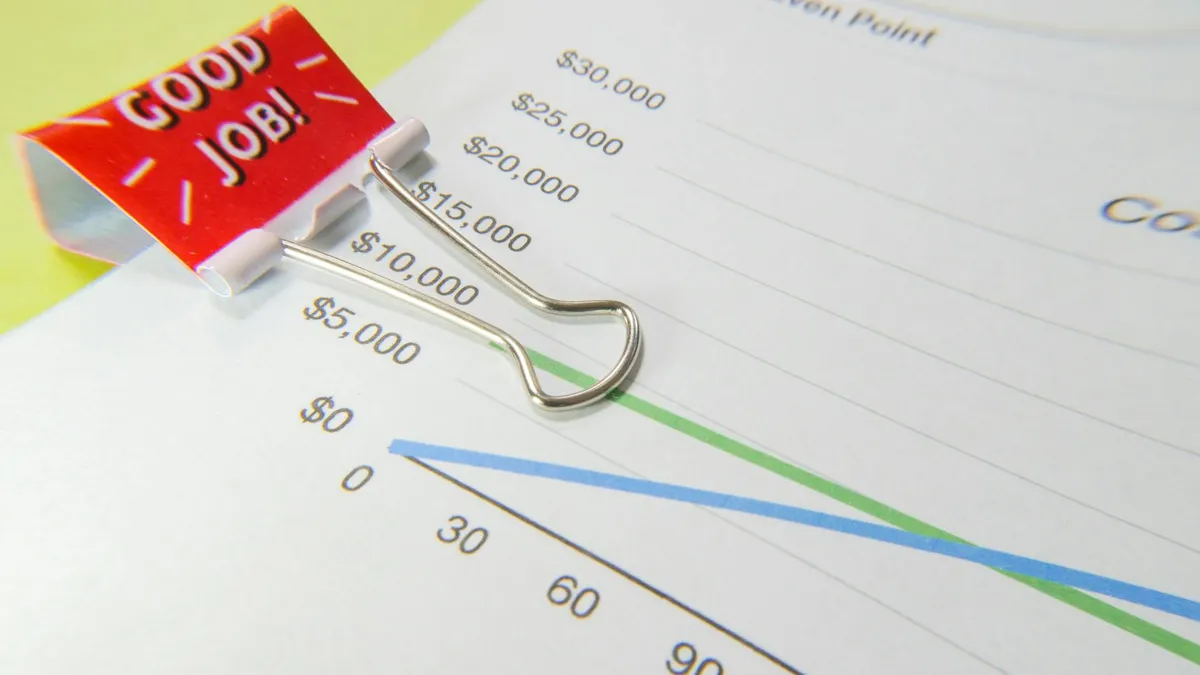
A break-even chart plots total revenue and total costs against sales volume, with the intersection marking the break-even point. According to MIT OpenCourseWare, visual break-even analysis helps managers identify profit zones, loss zones, and the margin of safety — the gap between actual sales and break-even that measures how much revenue can drop before losses begin.
Here is how to build one in a spreadsheet or Google Sheets:
The Components
- X-axis: Units sold (0 to your target volume)
- Y-axis: Revenue / cost in RM
- Line 1 — Total Revenue: Units × Selling Price (straight line from origin)
- Line 2 — Total Costs: Fixed Costs + (Units × Variable Cost Per Unit)
- Intersection: The break-even point
Reading the Chart
- Left of intersection: Loss zone. Total costs exceed revenue.
- Right of intersection: Profit zone. Revenue exceeds total costs.
- Margin of safety: The distance between your current sales volume and the break-even point. If you sell 200 units and break-even is at 117, your margin of safety is 83 units (41.5%). If revenue drops 41.5%, you still break even.
A healthy ecommerce store targets a margin of safety above 25%. Below that, one bad month — a supplier price increase, a seasonal dip, a Meta CPM spike — can push you into loss territory.
Frequently Asked Questions
How do you do a break even calculation for ecommerce?
Divide your total monthly fixed costs (rent, salaries, software subscriptions) by your contribution margin per unit (selling price minus all variable costs like COGS, shipping, and payment processing). The result is the number of units you must sell each month to cover all costs. For revenue-based break-even, divide fixed costs by your contribution margin ratio instead.
What is a good break-even point for an online store?
A good break-even point is one you can reach within the first 30-45 days of each month, leaving the rest for profit generation. For most DTC Shopify stores with 50-60% contribution margins and RM 10,000-15,000 in monthly fixed costs, break-even falls between 80-150 units or RM 15,000-25,000 in revenue per month.
How is break-even analysis different from break-even ROAS?
Break-even analysis calculates total sales volume needed to cover all business costs. Break-even ROAS calculates the minimum return on ad spend needed to cover variable costs on ad-acquired orders specifically. Break-even analysis uses the formula Fixed Costs / Contribution Margin. Break-even ROAS uses 1 / Net Profit Margin. Both are essential — use break-even analysis for business viability and break-even ROAS for ad campaign thresholds.
Does break-even analysis work for subscription ecommerce?
Yes. For subscription models, fixed costs stay the same, but contribution margin improves over the customer lifetime because acquisition cost (CPA) is only incurred once while revenue recurs monthly. Calculate initial break-even with CPA included, then recalculate excluding CPA for months two onward. Most subscription Shopify stores reach customer-level break-even by month three to four at 50%+ CM ratios.
Should I include ad spend in my break-even calculation?
Include ad spend as a variable cost per unit (cost per acquisition) when calculating ad-adjusted break-even. Do not include total ad budget as a fixed cost — it scales with volume. Add CPA to your variable cost per unit, then recalculate. A store with RM 103 contribution margin and RM 45 CPA has an adjusted CM of RM 58, which increases break-even from 117 to 207 units per month.
Keep Reading

Free Download
We audited 10 Shopify stores doing $1M–$20M. Here are the 15 leaks every one had.
Real screenshots (names blurred). Most operators have 8 of the 15 and don't know it.
From 10 audits across SG, MY, AE — fashion, beauty, electronics, food.
PDF in your inbox in 30 seconds. 1 email. No follow-up unless you ask.