Is your store leaking revenue?
Find out exactly where you're losing sales — takes 2 minutes.
A 30-minute script, three customer groups, and a method for turning transcripts into copy
Surveys told you nothing new.
You sent the post-purchase form. You got tidy answers. "Great product, fast shipping." Then you went back to guessing what to say in your ads.
The fix is not a better form. It is better customer interview questions, asked in the right order, to the right people. Here is the exact script, the rules that keep it honest, and the method that turns twelve conversations into words you can paste into a brief.
What Are the Best Customer Interview Questions for an Ecommerce Store?
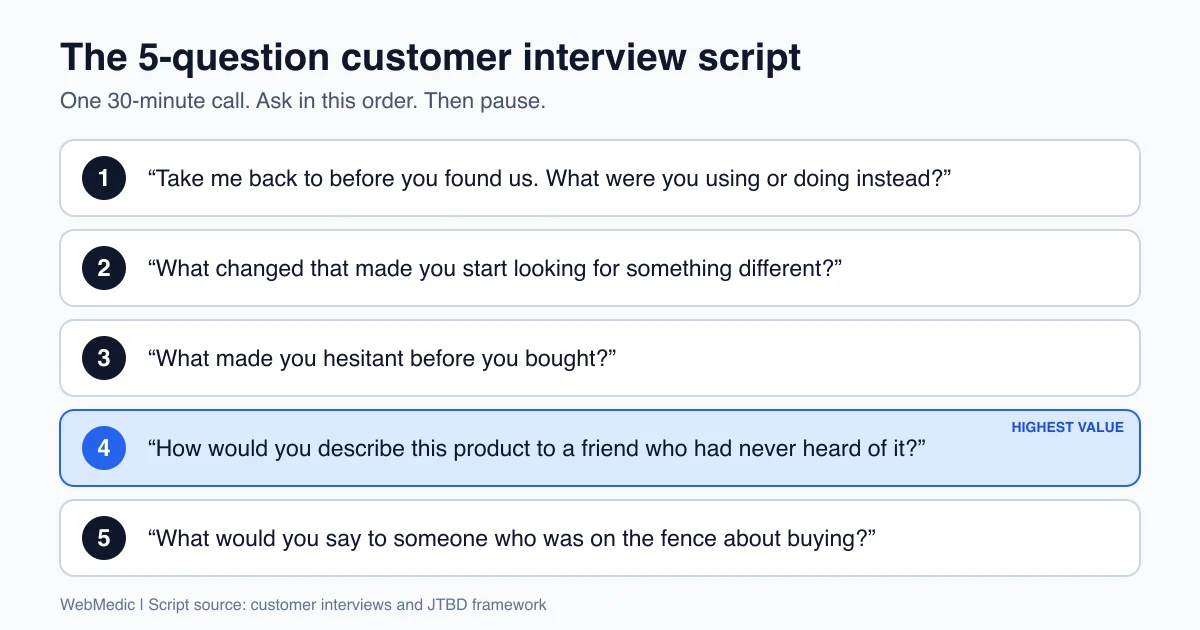
Five questions do most of the work.
A customer interview is a short, recorded conversation in which a buyer explains in their own words what led to a purchase. WebMedic's method uses five questions in a fixed order, in a call of 30 minutes or less, and treats question 4 as the highest-value one because it produces the customer's own positioning.
Ask these in order. Do not paraphrase them into something friendlier.
- "Take me back to before you found us. What were you using or doing instead?"
- "What changed that made you start looking for something different?"
- "What made you hesitant before you bought?"
- "How would you describe this product to a friend who had never heard of it?"
- "What would you say to someone who was on the fence about buying?"
Question 4 is the one to protect if the call runs short. The way a customer describes your product to someone else is often sharper positioning than your internal copy.
Why? Because your team describes the product from the inside. The customer describes it from the outside, using words a stranger would understand. Those are the words a stranger on your product page needs to read.
But there is a trap in how most stores collect this kind of data.
Why Do Surveys Fail Where Customer Interviews Work?
A survey gives you what customers think they should say.
Surveys fail because the format shapes the answer. In WebMedic's interview method, a founder sends a typeform, gets tidy responses, and believes they understand the customer, when what they have is what the customer thought they should say. Usability research from Jakob Nielsen at Nielsen Norman Group makes the same point: what users say and what they do are different.
A conversation is different. There is no box to tick. The customer has to tell the story, and stories contain the details a form never asks for: the failed alternative, the late-night search, the friend who mentioned the product, the worry about delivery.
Nielsen's Interviewing Users article is a fair caution. Interviews have weaknesses, and he says so. They explore; they do not measure. Use them to find out what customers feel and in which words, not to count how many feel it.
Surveys still have a job: sizing something you already know exists. Interviews find the thing you did not know to ask about.
So who do you call?
Who Should You Interview First?
Not your happiest customers.
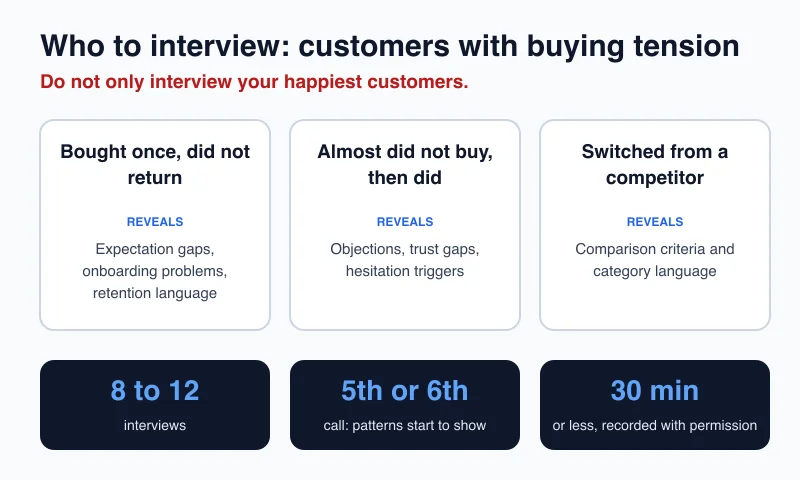
Interview customers with tension in their buying journey: those who bought once and did not return, those who almost did not buy and then did, and those who switched from a competitor. WebMedic's interview method sets one explicit rule: do not only interview the happiest customers, because those conversations tend to confirm what you already believe.
Happy customers are pleasant to talk to. They tell you the product is great. You feel good and learn very little.
Each of the three groups below reveals a different kind of usable tension.
| Group | What they reveal | Best use |
|---|---|---|
| Bought once and did not return | Expectation gaps, onboarding problems, retention language | Product pages, lifecycle email, retention messaging |
| Almost did not buy, then did | Objections, trust gaps, hesitation triggers | Ads, landing pages, FAQs, offer framing |
| Switched from a competitor | Comparison criteria, dissatisfaction, category language | Competitor comparison, differentiation, acquisition creative |
Source: WebMedic customer interview and Jobs To Be Done method.
The "bought once" group stings. Their answers are often the least flattering. They are also the most useful, because they tell you where the promise on your page and the reality in the box came apart.
You can pull all three groups from your Shopify order history. Filter for single-order customers, customers who abandoned a checkout and later completed it, and customers whose first order followed a competitor comparison page or a "switching from" discount code if you run one.
Does this sound like your store? If you do not know why buyers hesitate, start with the numbers. Find out where you are leaking revenue with the free Revenue Score. 3 minutes. Free. No pitch.
What Is the Jobs To Be Done Arc Behind the Five Questions?
Every purchase is hired to do a job.
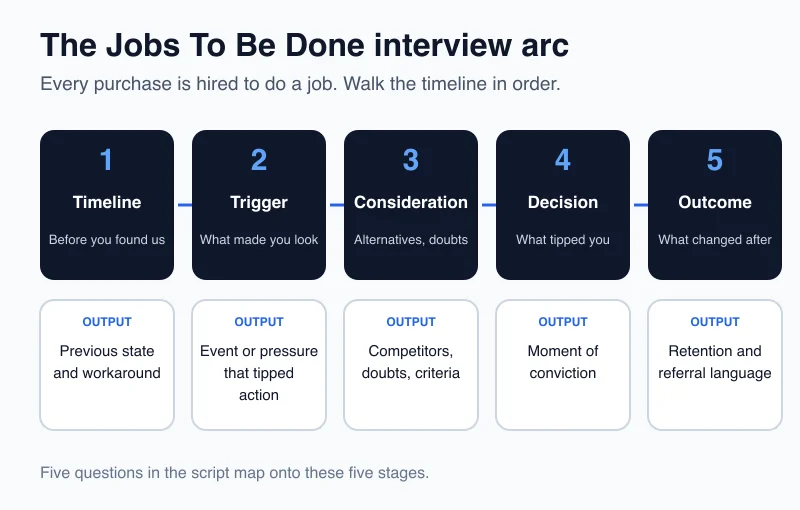
The Jobs To Be Done arc is a five-stage interview structure: timeline, trigger, consideration, decision and outcome. It comes from the idea, set out by Clayton Christensen and co-authors in Harvard Business Review in 2016, that customers hire products to make progress. The five questions in the script map onto these five stages.
The framing matters because the job is often different from what the brand assumes. You may sell a protein bar as a snack. A customer may have hired it to replace a skipped lunch. Those are two different ads.
The Harvard Business Review article, Know Your Customers' "Jobs to Be Done", is the source of the idea if you want the original argument.
Here is how the arc works in a call.
| Stage | Prompt | What you get |
|---|---|---|
| Timeline | What was happening before you found us? What were you using instead? | Previous state and workaround |
| Trigger | What happened specifically that made you start looking? | The event or pressure that tipped action |
| Consideration | What else did you look at? What made you unsure? | Competitors, doubts, buying criteria |
| Decision | What actually made you decide? | The moment of conviction, not polished hindsight |
| Outcome | What changed after using it? How would you explain it to a friend? | Retention, referral and outcome language |
Source: WebMedic customer interview and Jobs To Be Done method.
Look at the Decision row. "Moment of conviction, not polished hindsight" is the hard part. Customers will happily tell you a tidy reason after the fact. Keep asking "and what happened right before that?" until you reach the event itself.
For the wider map of what happens before and after the sale, see our guide to the ecommerce customer journey. The interview fills that map with real language.
How Many Customer Interviews Do You Need, and How Long Should They Run?
Eight to twelve, at 30 minutes or less.
Aim for eight to twelve customer interviews of 30 minutes or less, recorded with permission. In WebMedic's interview method, patterns often start emerging around the fifth or sixth conversation, so process your notes as a batch once you have six or more rather than one call at a time.
That is a small number on purpose. You are looking for repeated language, not a statistically valid sample.
Keep each call short: a 30-minute ask is easier to agree to than an hour, and it stops the call drifting into a sales conversation. Record it, so you can listen instead of typing and hear the word the customer uses twice.
A personal invite works better than an automated email sequence. Send it from a founder or team member, and include four things: how long it takes, what it is for, what they get in return, and why their experience matters. Here is a version you can adapt.
Hi {first_name}, I'm working on improving {product} and your
experience would genuinely help.

Would you be open to a 30-minute call this week? It is not a sales
call. I'd like to understand what was happening before you bought,
what nearly stopped you, and what the product did or did not solve.

As a thank-you, we'll send {store credit or small gift}. If you're
open to it, here are a few times: {times}.
A store credit or small gift is the usual thank-you. Keep it modest. A large reward attracts people who want the reward, not people with something to say.
What Rules Keep a Customer Interview Honest?
Six rules, and the pause matters most.
Six rules decide whether interview data is worth anything: do not pitch, do not defend the product, do not correct the customer's language, do not fill pauses too quickly, let the customer finish, and pause again when they stop. WebMedic's interview method notes the pause often produces the most honest addition.
Walk through them one at a time.
- Do not pitch. The call is not a sales call. The moment you sell, the customer starts being polite.
- Do not defend the product. If a customer says the packaging felt cheap, write it down. Do not explain the supplier.
- Do not correct their language. If they call your serum "the sticky one," that is data. It is not an error.
- Do not fill pauses too quickly. Silence feels awkward. Count to five anyway.
- Let them finish. Interrupting with a clever follow-up teaches the customer to give shorter answers.
- When they stop, pause before moving on. The extra sentence that comes after the pause is often the real answer.
Rule 3 is the one founders break most. You know the product well. You hear "it stops my hands cracking" and want to say "it is a barrier cream." Do not. Their phrase is the phrase the next buyer will search for and respond to.
Before every call, check that the customer is in one of the three groups, the incentive is clear, and recording permission is requested.
How Do You Run Customer Interviews in Malaysia and Singapore?
Let the customer pick the language.
In Malaysia and Singapore, run customer interviews in whichever language the customer chooses, often a mix of English, Malay and Mandarin. WebMedic's method keeps the 30-minute limit and the five questions, and treats any code-switching as data: record the exact words, then translate beside them rather than over them.
This is practical guidance from how our market works, not a separate study. It follows from rule 3. If a customer slips from English into Malay or Mandarin to describe a feeling, that switch often marks the moment the real word arrived. Write down the original word first. Add the English translation next to it.
A few local notes.
- WhatsApp is where your customers already are. A live call is best, because you can follow up. If a customer will not take a call, send the five questions as a short message and ask them to answer by voice note. You lose follow-ups, so treat it as a fallback, and ask a second round of questions once they reply.
- Voice notes are still recordings. Say so in your invite, and get a yes before you save or transcribe one.
- Keep the incentive proportionate. A store credit or a small gift fits a 30-minute call. It should not read as payment for a good review.
- Mind data protection. Malaysia has the Personal Data Protection Act 2010, and Singapore's Personal Data Protection Act is administered by the PDPC. Tell customers why you are recording, how long you will keep it, and who will hear it. This is practical guidance, not legal advice.
If you sell in both countries, run separate batches. A Kuala Lumpur buyer and a Singapore buyer can hire the same product for different jobs. Mixing them in one batch hides that.
How Do You Turn Twelve Conversations Into Copy?
Read everything. Then count words.
Process interview notes in seven steps once you have six or more calls: read everything, highlight repeated phrases, mark unexpected words, cluster hesitations, separate acquisition from retention problems, build a phrase document by theme, then write the creative brief. WebMedic's rule: one unexpected word used by three separate customers belongs in the copy.
Here are the seven steps in order.
- Read the notes and transcripts in full. Do not skim for quotes you like.
- Highlight exact phrases that repeat across different people.
- Mark unexpected words that several customers use for the same feeling, problem or outcome.
- Cluster recurring hesitations into themes.
- Separate acquisition objections from onboarding or retention problems. "I was not sure it would fit" is an ad and product page problem. "It arrived and I did not know how to start" is an onboarding problem. Different fix, different owner.
- Build a short document of verbatim phrases, organised by theme.
- Turn that document into your next creative brief.
"Unexpected" is the key word. If three customers say "good quality," ignore it. Everyone says that. Say three customers each say "it doesn't feel greasy" while your page says "lightweight formula." That is a gap between your language and theirs, and it belongs in the copy.
Once you have the words, they feed everything else. Your value proposition gets sharper because it uses the customer's own phrase. Your product descriptions answer the hesitations you actually heard. And your content strategy stops being a list of topics and becomes a list of questions real buyers asked.
What Goes in a Verbatim Phrase Brief?
Seven themes, each with a home.
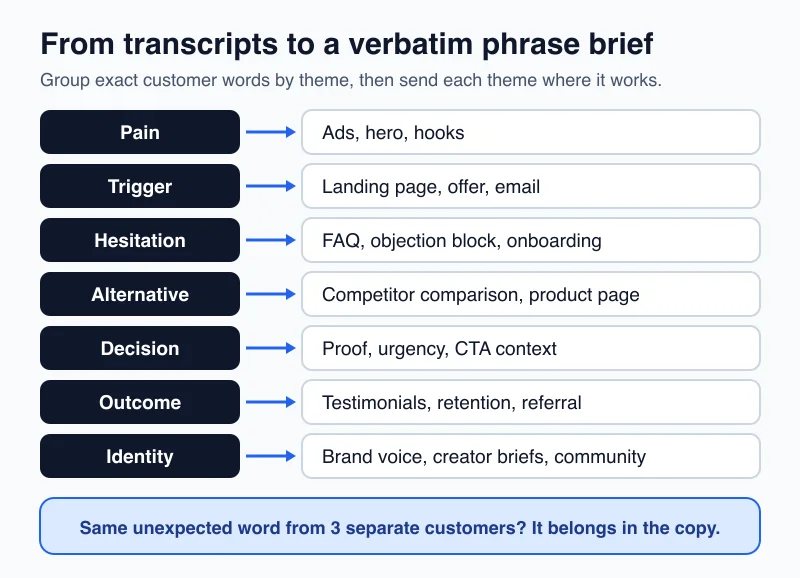
A verbatim phrase brief organises customer wording into seven themes (pain, trigger, hesitation, alternative, decision, outcome and identity), each mapped to a place in your marketing. WebMedic's interview method uses it as the handoff from research to copy, so a writer can work from the brief without rereading every transcript.
Use this table as the template. Add a frequency count beside each phrase, and a one-line implication.
| Theme | Customer language to capture | Where to use it |
|---|---|---|
| Pain | How they describe the problem | Ads, hero, hooks |
| Trigger | The event that made them look | Landing page, offer, email |
| Hesitation | What nearly stopped them | FAQ, objection block, onboarding |
| Alternative | What they used or compared | Competitor comparison, product page |
| Decision | What tipped them | Proof, urgency, CTA context |
| Outcome | What changed afterwards | Testimonials, retention, referral |
| Identity | How they describe themselves | Brand voice, creator briefs, community |
Source: WebMedic verbatim phrase brief format.
Keep the exact wording. Do not tidy it. "I kept putting it off because I thought it would be a hassle to return" is more useful than "return anxiety."
This is also where interview research differs from competitor research. Looking at what rivals do, as in our guide to stealing ideas from DTC brands, tells you what the market already says. Customer interviews tell you what your own buyers say, which is the part nobody else can copy.
How Do You Know Your Customer Interviews Worked?
If they only confirmed your plan, they failed.
A good set of interviews surprises you. WebMedic's interview method uses one self-check: if the output only confirms the current strategy, you probably led the conversation or interviewed too narrow a group. Before using the data, confirm you reviewed six or more interviews, covering at least two customer types.
Run three checks before you turn the notes into strategy:
- Six or more interviews were reviewed together, with at least two customer types.
- The notes keep exact customer wording, and the real decision trigger is separated from hindsight.
- At least one finding changed what the team assumed.
The "surprise" check is the honest one. If nothing changed, the likely cause is not that you already understand your customer perfectly. It is that you asked leading questions, or only called people who like you.
For the next batch, add a customer from the "bought once" group and ask question 3 more slowly.
Frequently Asked Questions
What are good customer interview questions for ecommerce?
Use five: what they did before finding you, what changed, what made them hesitate, how they would describe the product to a friend, and what they would tell someone on the fence. WebMedic's method runs them in that order in a call of 30 minutes or less.
How many customers should I interview?
Aim for eight to twelve. Patterns often start emerging around the fifth or sixth conversation, so wait until you have at least six before processing notes as a batch. Cover all three customer groups before you add more calls.
Why are interviews better than surveys for customer research?
A survey records what customers think they should say, shaped by the form. An interview of 30 minutes or less lets them tell the story, including the failed alternative and the doubt before buying. Use surveys to size a known issue and interviews to discover unknown ones.
Should I interview my best customers?
Not only them. Happy customers tend to confirm what you already believe. Prioritise the three groups with tension: customers who bought once and did not return, who almost did not buy, and who switched from a competitor. Start with two or more of those groups in your first six interviews.
What should I pay customers for an interview?
Offer a modest store credit or small gift for a 30-minute call, and state it in the invite. Keep it proportionate so you recruit people with something to say, not people chasing a reward. Never tie the incentive to a positive review or a purchase.
Keep Reading

Free Download
We audited 10 Shopify stores doing $1M–$20M. Here are the 15 leaks every one had.
Real screenshots (names blurred). Most operators have 8 of the 15 and don't know it.
From 10 audits across SG, MY, AE — fashion, beauty, electronics, food.
PDF in your inbox in 30 seconds. 1 email. No follow-up unless you ask.