Is your store leaking revenue?
Find out exactly where you're losing sales — takes 2 minutes.
The one-page policy that stops your best customers from learning to wait for a sale
What Is a Discount Strategy?
Discounts are not the problem.
A discount strategy is a written policy that decides which customers receive a discount, how deep it goes, and through which channel it appears. Retention research by Frederick Reichheld of Bain & Company found that a 5% rise in customer retention lifts profit by 25% to 95% (Harvard Business Review, 2014). That is why who you discount matters more than how deep.
Most stores treat a discount strategy as a calendar. A sale in March, a flash sale in June, a big push on 11.11. That is a promotion schedule. It tells you when you discount. It does not tell you who is allowed to get one.
A real policy answers four questions in writing:
- Who is eligible, and who is protected?
- Which channels may show a discount?
- What replaces the discount for people who do not need one?
- How do we unwind the offers we already run?
We write this as a one-page document a marketing lead can hand to the team. The page is the deliverable. Without it, every channel owner makes their own call, and the store ends up with five discount rules that fight each other.
This article is the full policy build. It covers the mechanism behind the margin leak, the spiral that locks stores into it, and the exact steps to get out. It does not cover offer design, pricing models or campaign calendars. For those, see ecommerce pricing strategy, ecommerce holiday sales and how to build an irresistible offer.
Let's start with the cost nobody can see.
What Is Subsidy Cost and Why Is It Invisible on the P&L?
A shopper arrives with a card in hand.
Subsidy cost is the cost a business spends to acquire a customer who would have bought at full margin anyway. In the standard example, a ready-to-buy visitor sees a 20% off popup and takes it, so that 20% is pure margin given away with zero acquisition benefit. The 20% is an illustrative figure from the operator playbook we work from, not a benchmark.
Picture it. Someone clicks an ad, reads the product page, reaches for their wallet. Then a popup slides across the screen offering 20% off the first order. They take it. Of course they do. You just paid them to do what they were already doing.
On your P&L, that 20% does not look like a cost. It hides inside the discount line, next to the sale you ran on purpose. Nobody flags it because nothing broke. Revenue came in. The order shipped.
Here is the operating rule that follows from it:
Every discount given to a customer who would have purchased anyway is a direct hit to gross margin with zero acquisition benefit.
There is no neat formula for subsidy cost, and we will not invent one. The source framework does not give one. What you can do is stop the biggest leaks first. Those are the always-on mechanisms that hand a discount to everyone on arrival. We list them in the audit step below.
Why does a store keep doing this? Because it feels safe. And that feeling is exactly what drives the next problem.
How Does the Price-CAC Spiral Trap a Store?
It starts with a small, reasonable-looking move.
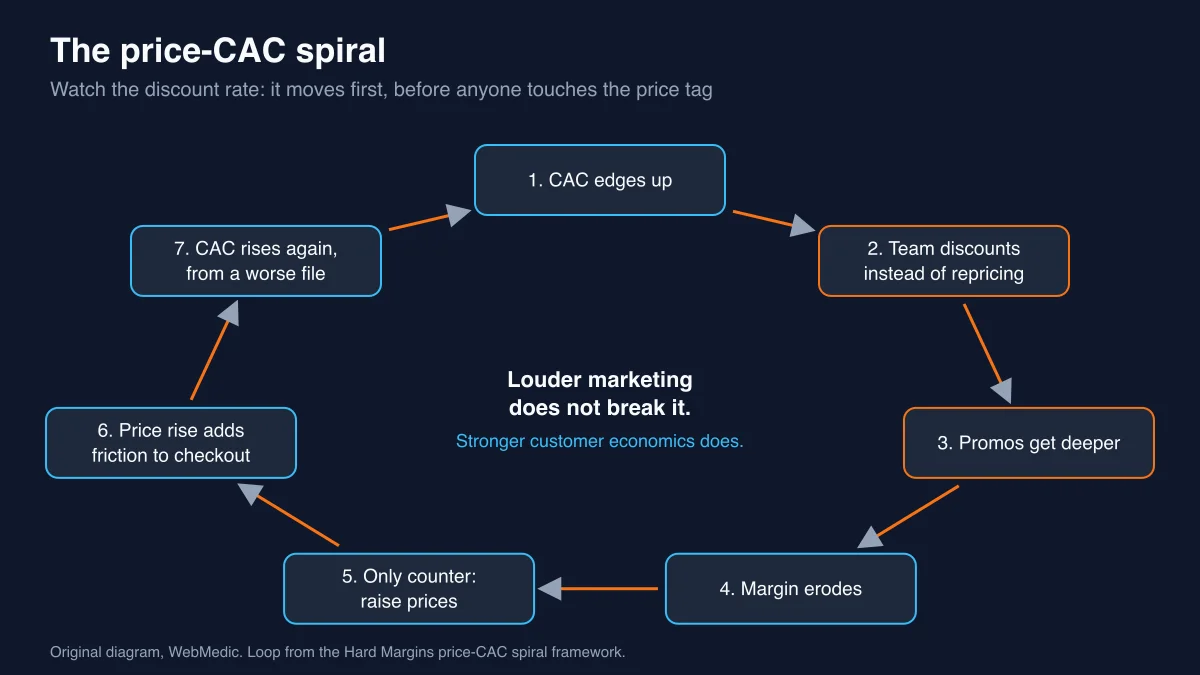
The price-CAC spiral is a seven-step loop in which rising customer acquisition cost (CAC) triggers discounting, discounts erode margin, and the forced price rise adds friction that pushes CAC up again. The framework describes it as a twelve-month slide, and the early-warning signal is the discount rate, which moves before any price changes (Hard Margins framework).
Here are the seven steps, in order:
- CAC edges up.
- The first response is to discount, not to raise prices.
- Promos get deeper.
- Margin erodes.
- The only counter left is a price rise.
- The price rise adds friction to every conversion.
- CAC edges up again, from a higher base, with a worse customer file.
Read steps two and three again. The discount moves first. That makes the discount rate your early-warning signal. If it climbs while your prices stay flat, you are inside the loop.
The line from the framework is blunt: louder marketing does not break the spiral. Stronger customer economics does.
By the time most operators spot it, they have spent a year making the business more expensive and more fragile at once. And there is a companion loop that is just as nasty.
How Do You Tell If You Are in a Discount Death Spiral?
Run four checks on your financials.
The discount death spiral is a loop where a revenue dip triggers discounts, discounts attract customers who only buy on discount, and those buyers replace full-margin buyers. Four financial checks confirm it: a growing discount line, a falling average sale price over 12 to 24 months, list growth tied to a percent-off popup, and repeat customers redeeming high-percentage codes.
The loop runs like this. Revenue dips. The team discounts. The discount pulls in a cohort that only buys on discount. Discount buyers replace full-margin buyers, so the average price falls. The team discounts more to hold revenue. The end state is a sentence every founder dreads: "I have to discount, or no one buys."
Check yourself against this list:
| Check | Where to look | Warning sign |
|---|---|---|
| Discount line | P&L and Shopify discount reports | Large and growing month on month |
| Average sale price | Orders over 12 to 24 months | Trending down |
| List growth | Email platform sign-up source | Most new subscribers come through a percent-off popup |
| Repeat behaviour | Orders by customer | Repeat customers redeem high-percentage codes |
Source: four verification checks from the Pricing and Discount Unwinding playbook (Ecommerce Acquisitions framework).
One tick on the list is a flag. Two or more means you are likely in the loop.
When we audit a Shopify store, we check how many discount mechanisms are live at the same time before we look at anything else. Stores in trouble rarely have one. They have a popup, a banner, an email-one code and an affiliate code, all stacking.
Does this sound like your store? Find out where you are leaking revenue. Take the free Revenue Score. 3 minutes. Free. No pitch.
Now to the fix. It starts with deciding who you will not discount.
Who Should Never Receive a Sitewide Discount?
Your full-price buyers.
A full-price protected segment is a group of customers excluded from sitewide discounts, retargeting promos and generic win-back flows. A customer qualifies only when all three criteria hold: they bought without a discount, they rarely use promos, and they stay profitable after returns. That makes three tests, all required (Hard Margins discount policy framework).
Here are the three criteria, spelled out:
- Bought without a discount. They paid the sticker price at least once.
- Rarely use promos. Their history shows no pattern of waiting for a code.
- Stay profitable after returns. This one is easy to skip, and it carries the weight. A customer who buys at full price and returns half of it is not a protected customer.
Pull this segment in Klaviyo or your Shopify customer list. Shopify's discount documentation shows how codes and automatic discounts are applied, which is where you check what is live. Then suppress it from sitewide discounts, retargeting promos and generic win-back flows.
Now the part people get wrong. Going quiet on them is not the goal. You are not ignoring them. You are changing what you send them. They still get email, still see ads. The message just stops saying "how cheaply" and starts saying "what's new".
That brings us to the weak link in every suppression plan.
How Do You Build a Promo Firewall Across Every Channel?
Write one rule. Apply it everywhere.
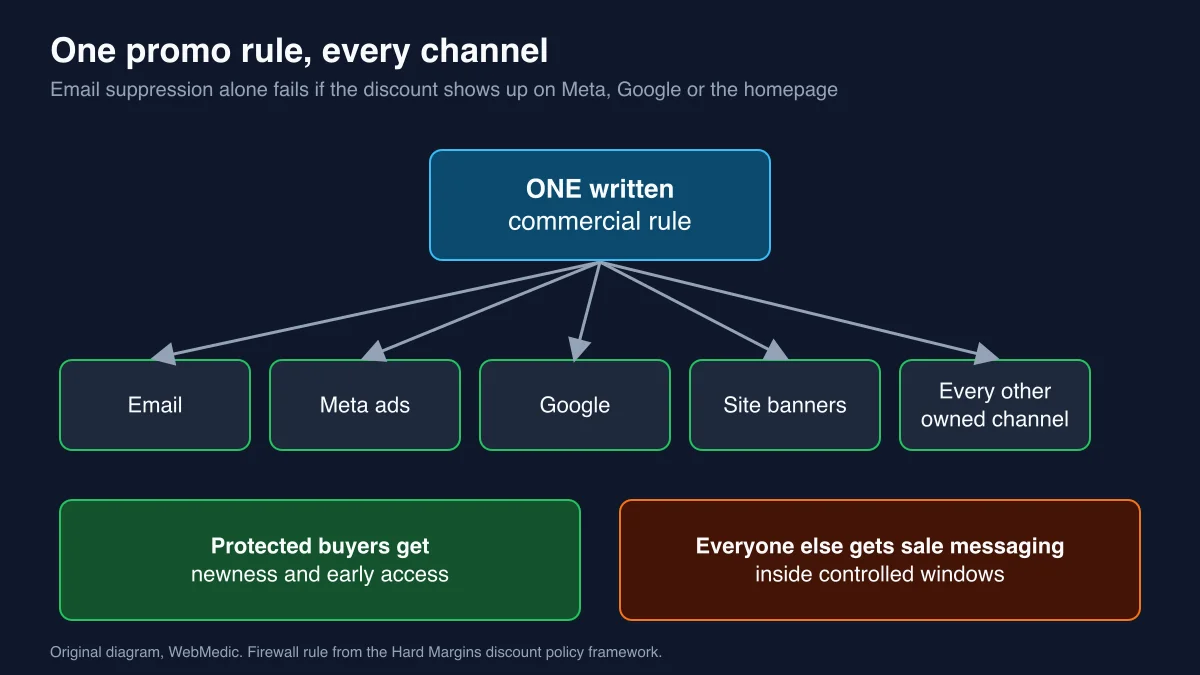
A promo firewall is one written commercial rule enforced across every channel, so a protected customer never catches a discount anywhere. Email suppression alone fails if the same customer sees a code on Meta, on Google or on a homepage banner. The coverage list starts at four channels (email, Meta, Google, on-site banners) and extends to every channel you own.
A firewall with one hole is not a firewall. A protected customer who gets no email discount but lands on a 15% off banner has just learned that a sale is always one click away.
Use this table as your channel checklist:
| Channel | What the policy sets | Common hole |
|---|---|---|
| Suppress the protected segment from sale sends and discount flows | Welcome series with a code in email one | |
| Meta ads | Exclude the protected segment from promo audiences | Retargeting audiences built from all site visitors |
| Exclude the protected segment from promo ads and remarketing lists | Brand search ads carrying a standing offer | |
| On-site banners | Hide sitewide offers from logged-in protected buyers | Always-on "20% off everything" bar |
| Every other owned channel | Apply the same rule: SMS, affiliates, influencer codes | Evergreen affiliate codes that never expire |
Source: channel coverage checklist adapted from the Hard Margins discount policy framework. The four named channels are a floor, not a scope.
Who gets what, then? Protected buyers get newness and early access. Everyone else gets sale messaging, kept inside controlled windows in front of the people it is actually meant for.
A note on the hole most stores miss. Your exit popup. If it offers a deeper discount than your welcome popup, shoppers learn to close the first one and wait for the second. We cover the exit-intent setup in the exit popup guide.
What Can You Offer Instead of a Discount?
Give them a reason to come back.
Four non-discount replacements keep protected customers buying without a price cut: replenishment reminders, next-best product recommendations, early access and limited drops. The principle from the framework is that for a customer who already accepts your price, the next message should answer why to buy next, not how cheaply.
Think of it as a rhythm. Your best customers already buy on their own schedule. A blanket discount interrupts that rhythm. It teaches them to wait.
Here is each replacement and a practical use:
- Replenishment reminders. A skincare bottle that lasts about two months gets a reminder around week seven. No code. Just timing.
- Next-best product recommendations. Show what customers who bought this item usually buy next. Klaviyo and most Shopify recommendation apps can do it.
- Early access. Let protected buyers see new products before everyone else. Early access is a perk you can offer without cutting a price.
- Limited drops. A small run of a product, announced to this segment first.
None of these touch your margin. Each one gives the customer a reason to act that is not a price cut.
One honest caveat. A premium operator in the source material also leaned on a tiered loyalty program (bronze, silver, gold) as an alternative currency, and said customers bought more without heavy discounts. He gave no figures, so treat it as one operator's account, not a proven lift.
Which Customers Qualify for a Discount at Each Stage?
Escalate only when the step before has failed.
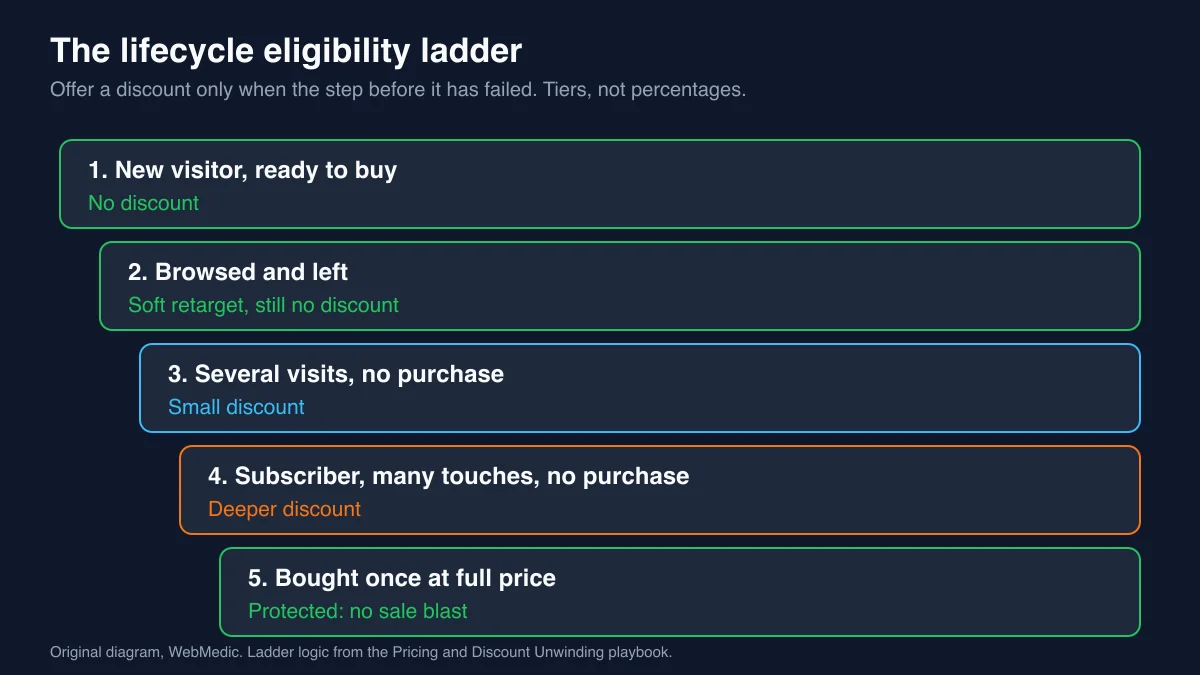
A lifecycle eligibility ladder gives a discount only to customers who still need one. It has five tiers: ready-to-buy visitors get none, browsers get soft retargeting, multi-visit non-converters get a small discount, subscribers with several untouched emails get a deeper one, and full-price buyers are protected. The source names the principle but gives no exact percentages.
Each rung is a chance to convert at full margin before any discount is offered. The discount is the last resort, not the first move.
| Customer state | What they get | Why |
|---|---|---|
| New visitor, ready to buy | No discount | They will complete checkout at full margin |
| New visitor, browsed and left | Soft retargeting, still no discount | A reminder is often enough |
| Multi-visit non-converter | Small discount | Hesitation is real, so start below your old welcome offer |
| Subscriber, no purchase after multiple touches | Deeper discount | They have shown they need more |
| Bought once at full margin | Protected | Do not train them to wait for sales |
Source: lifecycle ladder from the Pricing and Discount Unwinding playbook. Tune the depth of each tier to your own margins.
We deliberately show tiers, not percentages. The framework does not set the numbers, and a number copied from another brand is not your number. Set depths against your contribution margin, then test.
For reference, one operator at a heritage premium brand described cutting inherited 40 to 50% discounts to roughly 20 to 25% for bank-holiday sales, with Black Friday capped near 35%. He recalled these from memory and hedged them. Read them as one brand's decisions, not as targets.
How Do You Wean a Store Off Discounts Over 12 Months?
You cannot flip a switch.
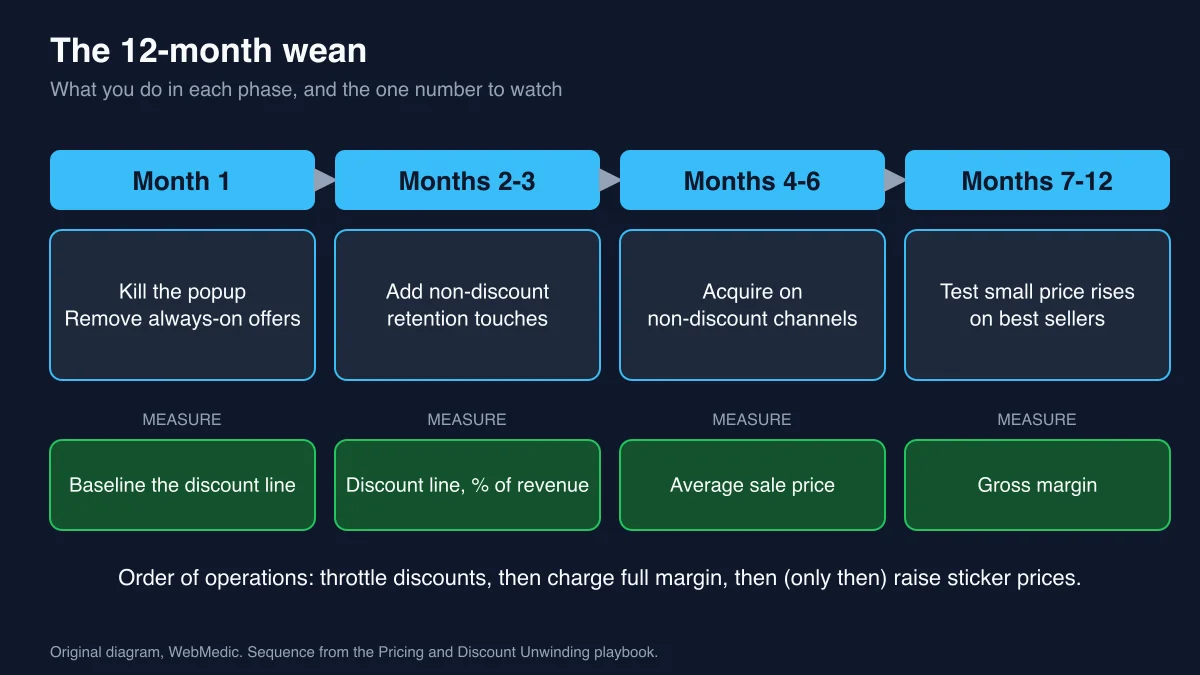
A discount wean is a 12-month sequence that removes discount triggers in order while a new, non-discount cohort replaces old discount buyers. Month 1 kills the popup and always-on offers, months 2 to 3 add retention touches, months 4 to 6 shift acquisition, and months 7 to 12 test small price rises (Ecommerce Acquisitions playbook).
Kill discounts overnight and revenue drops. The old customers are trained to buy on sale. You have to flush them out and replace them with customers who never knew you as the discount brand. That takes time.
Day one is different. These moves cost you nothing in price:
- Replace the welcome popup with an exit-intent offer, or with a non-discount newsletter sign-up.
- Remove spin-the-wheel popups.
- Take down the standing "20% off everything" banner.
- Rewrite email one so it leads with the brand, not a code.
- Audit affiliate and influencer evergreen codes, and deactivate the old ones.
- Baseline the discount line on your P&L so you can see it fall.
Then follow the phases:
| Phase | What you do | What you measure |
|---|---|---|
| Month 1 | Kill the popup and always-on offers | Baseline the discount line |
| Months 2 to 3 | Add non-discount retention touches and lifecycle flows | Discount line as a percentage of revenue starts falling |
| Months 4 to 6 | Acquire on non-discount channels; old discount-only buyers churn | Average sale price begins to climb |
| Months 7 to 12 | Selectively test small price rises on best sellers | Gross margin is restored |
Source: sequenced 12-month wean from the Pricing and Discount Unwinding playbook.
Expect pain in months four to six. Discount-only customers will leave. That is not a failure. It is the process working.
One alternative is worth knowing. A premium-brand operator in the source material "ripped the band-aid off" in one move, because profitability left him no choice. He still did not go to zero. He cut depth, limited the occasions and kept discounting where it made sense. Rip-off is a forced move, not a default one.
In What Order Should You Cut Discounts and Raise Prices?
Throttle discounts first.
The order of operations is three steps: throttle discounts, then charge full margin on more inventory by removing discount mechanisms, and only after that consider raising sticker prices. In the framework's account, most turnaround "price rise" wins actually came from stopping discounts, not from changing the price tag (Ecommerce Acquisitions playbook).
This order protects you from step six of the price-CAC spiral. A sticker price rise adds friction to every single conversion. Removing a discount mechanism only changes what a subset of shoppers pays.
So you can raise your realised price without touching the label. Fewer customers get the discount, more orders land at full margin, and your average sale price climbs on its own.
Our advice: do not touch sticker prices until your discount line is falling and your average sale price is rising. If you are still in months one to three, you are not ready. For how to set the sticker price itself, see the pricing strategy guide.
How Does a Discount Policy Survive 11.11, 12.12 and Marketplace Pressure?
Marketplaces will out-discount you.
A DTC store cannot win a percent-off war against Shopee or Lazada, so its policy must hold on 9.9, 10.10, 11.11 and 12.12 without matching them. Singapore and Malaysia compress four marketplace mega-sales into four months, which is why the eligibility rules must be written before September, not improvised during a sale.
In Malaysia and Singapore, the season runs from 9.9 through 12.12, with 10.10 and 11.11 between them. When a marketplace shouts 50% off, the pressure to match it is strong. Don't. You cannot out-discount a platform that funds its own promotions.
Here is how to stay inside your policy:
- Sale messaging goes to the right audience. Controlled windows, aimed at the customers meant for them, not the protected segment.
- Protected buyers get early access. Offer them the new drop before the sale window opens.
- Use the ladder, not a blanket. Multi-visit non-converters and cold subscribers get the offer. Full-price buyers do not.
- Make the sale one-time and visible. Run it as a dated event with an end, not a standing banner.
This is what a policy buys you. You can run a season and still know which customers took a discount and why. Without one, 11.11 becomes the day you retrain your best customers to wait.
For the planning side of these events, the holiday sales calendar covers lead times. If you want a second pair of eyes on your promo setup, our Shopify Singapore team audits it as part of a store review.
Frequently Asked Questions
What is a good discount strategy for an ecommerce store?
A good discount strategy is a written policy that limits discounts to customers who need them. Protect full-price buyers, enforce one rule across email, ads and banners, and escalate offers only as hesitation grows. Bain research cited by HBR links a 5% retention gain to 25% to 95% more profit.
What is subsidy cost in ecommerce?
Subsidy cost is the money a business spends to acquire a customer who would have bought at full margin anyway. For example, a ready-to-buy visitor takes a 20% off popup they did not need. The 20% is illustrative, and the cost hides in the discount line of the P&L.
How long does it take to stop relying on discounts?
Plan on about 12 months. Month one removes the popup and always-on offers, months two to three add retention touches, months four to six move acquisition to non-discount channels, and months seven to twelve test small price rises. Expect discount-only customers to churn between months four and six.
Should I stop discounting completely?
No. The goal is eligibility, not zero discounts. One premium operator cut depth and limited occasions such as bank holidays, summer sales and Black Friday, but kept discounting where it made sense. Reserve discounts for customers whose behaviour earns them, and keep your pricing credible for everyone else.
Keep Reading

Free Download
We audited 10 Shopify stores doing $1M–$20M. Here are the 15 leaks every one had.
Real screenshots (names blurred). Most operators have 8 of the 15 and don't know it.
From 10 audits across SG, MY, AE — fashion, beauty, electronics, food.
PDF in your inbox in 30 seconds. 1 email. No follow-up unless you ask.