Is your store leaking revenue?
Find out exactly where you're losing sales — takes 2 minutes.
A dated, counted look at public BNPL copy on Malaysian Shopify stores, with the method and the gaps
Eighteen stores said it out loud.
Last updated 28 November 2026. Data collected 16 to 17 November 2026 (Malaysia time). This page is a counted sample, not a market survey.
What Does the Study Find About Shopify BNPL in Malaysia?
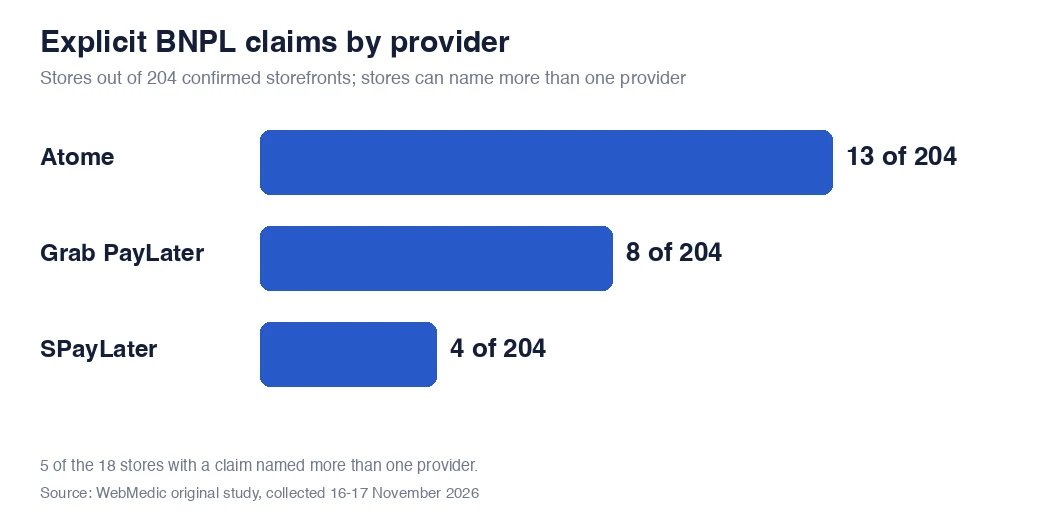
Buy now, pay later (BNPL) is a payment method that splits a purchase into instalments. In WebMedic's study of 204 confirmed Malaysian-market Shopify storefronts, 18 named a BNPL provider in the public page copy we checked. Atome appeared at 13 stores, Grab PayLater at 8 and SPayLater at 4.
Those are the headline counts for BNPL on Malaysian Shopify stores. Here are the findings as short, quotable lines. Every line names its base.
- 204 of 300 candidate storefronts were corroborated as Shopify stores serving a Malaysian market.
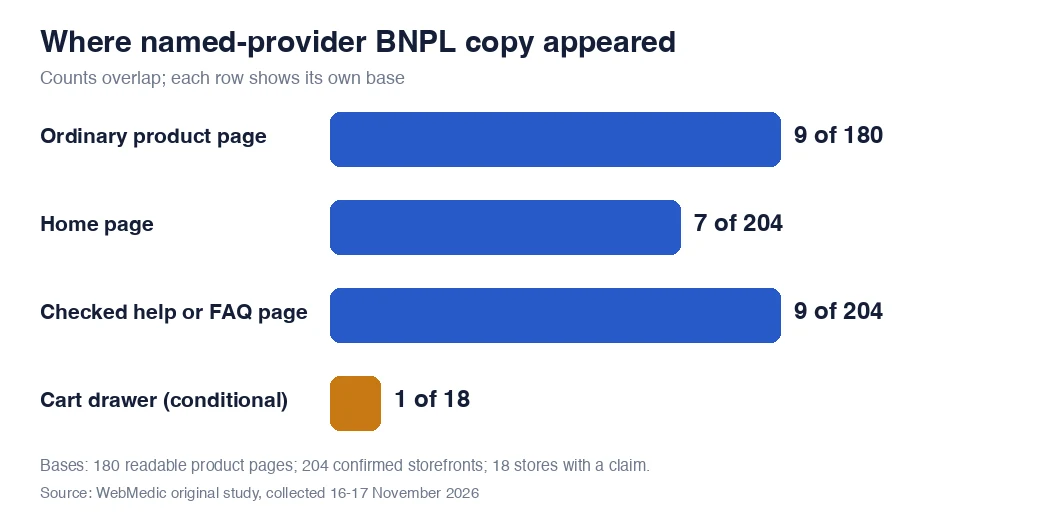
- 18 of 204 confirmed storefronts contained explicit named-provider BNPL claims in checked public page copy. One of the 18 was a conditional cart-drawer claim.
- 13 of 204 named Atome with BNPL or instalment terms.
- 8 of 204 named Grab PayLater.
- 4 of 204 named SPayLater.
- 5 of 18 stores with explicit BNPL claims named more than one provider.
- 9 of 180 checked readable product pages contained explicit named-provider BNPL copy.
- 7 of 204 had named-provider BNPL copy on the home page.
- 9 of 204 had it on a checked help or FAQ page.
- 0 of 204 had a completed checkout-method verification. The checkout-only share is unknown.
The same numbers sit in one table, so you can lift them without losing the base.
| Measure | Count | Base |
|---|---|---|
| Candidate storefronts frozen before coding | 300 | Store Leads Malaysia frame |
| Confirmed Shopify, Malaysian-market storefronts | 204 | 300 candidates |
| Explicit named-provider BNPL claim in checked public copy | 18 | 204 confirmed |
| Atome | 13 | 204 confirmed |
| Grab PayLater | 8 | 204 confirmed |
| SPayLater | 4 | 204 confirmed |
| More than one named provider | 5 | 18 stores with a claim |
| Ordinary product page with named-provider copy | 9 | 180 readable product pages |
| Home page with named-provider copy | 7 | 204 confirmed |
| Checked help or FAQ page with named-provider copy | 9 | 204 confirmed |
| Checkout-method verification completed | 0 | 204 confirmed |
Source: WebMedic original study, collected 16 to 17 November 2026. Provider and placement counts overlap, so they do not add up to 18.
We are not giving you an adoption rate. The sample is a convenience sample and it cannot speak for Malaysia. But the counts are dated, and a second reviewer reproduced them.
Why does that matter? Because the BNPL figures quoted around Malaysian ecommerce are mostly provider claims. This page counts what stores actually show.
How Did We Run the Study?
Method first, because the counts mean nothing without it.
We froze the first 300 unique merchant hostnames from the Store Leads Malaysia report and its linked region and city reports before coding any payment claim. We then confirmed 204 as Shopify stores serving Malaysia, left 87 unresolved and excluded 9 as outside the inspected storefront scope.
The frame came from the Store Leads Malaysia report, then its linked region reports, then its linked city reports, in breadth-first listing order. There were 161 logical directory URLs. Of these, 96 were readable and 65 failed. Rankings and those failures bias the frame. It is not random and it is not exhaustive.
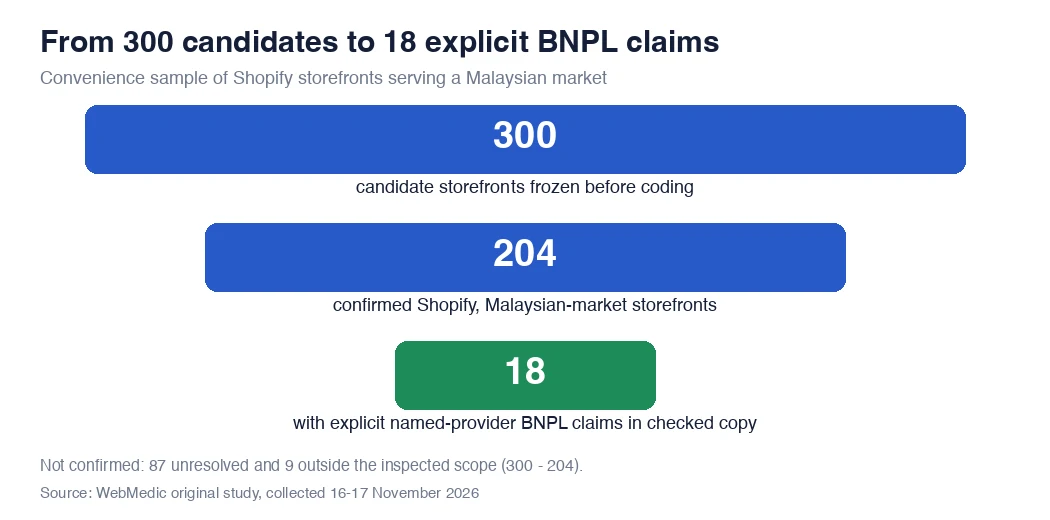
How we confirmed a store. We needed two things. First, merchant-side Shopify configuration, or a powered-by Shopify header or footer. Second, Malaysian-market evidence: ringgit prices, a Malaysian address or explicit local delivery or service. A directory label, a visitor-country setting or a global USD country selector alone did not count.
What we read. One ordinary product page per store where we could find one, plus the home page and targeted payment, help or FAQ pages where they could settle a doubt. Gift cards and invoices were swapped for an ordinary product. We placed no orders and submitted no personal details.
What we counted. An explicit online BNPL, PayLater or instalment term, with a provider named in text, in an adjacent logo or in a direct merchant payment link within the same offer. Ordinary e-wallets, bank-card instalments, offline-only methods, inactive templates and legacy Hoolah copy stayed outside the count.
What went wrong along the way. Many first reads returned HTTP 429, the "too many requests" response. We switched to a direct HTTP route with an openly named research user agent and kept the HTML, headers, URL and date for each item. The earlier failures were kept, not overwritten. Paid render checks were small pilots. Some failed. One showed that static text had included an inactive template, which is why that signal sits outside the count.
Who judged the pages. Analysts read the retained pages and saved a decision and passage for each item. Code counted those decisions. It never inferred a negative from a page that failed to load. A separate reviewer independently reproduced all 14 findings before we published.
Which BNPL Providers Do Malaysian Shopify Stores Name?
Atome leads. By a wide margin.
Of 204 confirmed Malaysian-market Shopify storefronts, 13 named Atome, 8 named Grab PayLater and 4 named SPayLater with explicit BNPL or instalment terms in checked public copy. Five of the 18 stores with a claim named more than one provider, so the counts overlap.
Here is how the provider counts sit next to each other.
| Provider | Stores with explicit BNPL claim (of 204) | Stores with logo or listing only (of 204) |
|---|---|---|
| Atome | 13 | 8 |
| Grab PayLater | 8 | None listed |
| SPayLater | 4 | 1 |
Source: WebMedic original study, 16 to 17 November 2026. Stores can appear under more than one provider.
A few merchants show what an explicit claim looks like. TAHAN Outdoor and Calawo showed Atome instalments on the products we sampled. MR.DIY paired SPayLater with instalment terms on its home page and on related-product cards. PP Signature's four-month online offer linked directly to its Grab PayLater page, alongside a separate Atome offer.
Five stores listed more than one provider. A shopper at those stores sees a choice. A shopper elsewhere sees none, or does not see it until later.
The eight stores that showed Atome logos or listings without BNPL terms matter too. They suggest a provider is present, but we could not read a claim. So we counted them apart. One of the eight, Des Optics, also featured SPayLater.
Want to know which provider fits your margins and your shoppers? Our BNPL provider comparison for Malaysian Shopify stores compares Atome, Grab PayLater, ShopBack PayLater and Afterpay by store fit and lists the provider-reported conversion figures with their sources.
Where Do Malaysian Shopify Stores Show BNPL?
Page by page, the picture splits.
Nine of 180 readable ordinary product pages contained named-provider BNPL copy. Seven of 204 confirmed storefronts carried it on the home page and 9 of 204 on a checked help or FAQ page. These placements overlap, and rendered visibility was not verified across the sample.
Product placement here means named-provider copy exists in the product page's HTML or text. It includes product-detail payment blocks, related-product cards, shared announcements and accessible finance details.
| Placement | Stores with named-provider BNPL copy | Base |
|---|---|---|
| Ordinary product page | 9 | 180 readable product pages |
| Home page | 7 | 204 confirmed storefronts |
| Checked help or FAQ page | 9 | 204 confirmed storefronts |
| Shared cart drawer (conditional) | 1 | 18 stores with a claim |
Source: WebMedic original study, 16 to 17 November 2026. Placements overlap.
Some stores did the work properly. Shopython named Atome, SPayLater and Grab PayLater in the product's payment block and in a shared announcement. Machines and Lian Star explained BNPL on help pages. Machines also put separate bank-card plans, PayLater by Grab and Atome side by side in the product's finance panel.
Madre is the odd one. Its Atome badge, offering three interest-free payments, sits in the shared cart drawer. Both saved pages hide that footer while the cart is empty. So we counted Madre once, under conditional cart-drawer placement.
Twenty-four of the 204 stores lacked a readable ordinary product page that we could check. That is why the product-page base is 180, not 204.
But here is the catch. Page copy is only one part of the picture.
What Did We Leave Out of the Count?
A claim is not always a claim.
We excluded signals that look like BNPL but are not an active online claim. Of 204 confirmed storefronts, 8 showed provider logos or listings without explicit BNPL copy, 1 had an Atome claim in an inactive product template and 1 kept a legacy Hoolah instalment page.
Each exclusion has a reason.
| Signal | Stores | Counted in the 18? |
|---|---|---|
| Explicit named-provider BNPL claim | 18 | Yes |
| Provider logo or listing without explicit BNPL claim | 8 | No, counted separately |
| Atome claim confined to an inactive product template | 1 | No |
| Legacy Hoolah instalment page | 1 | No |
Source: WebMedic original study, 16 to 17 November 2026.
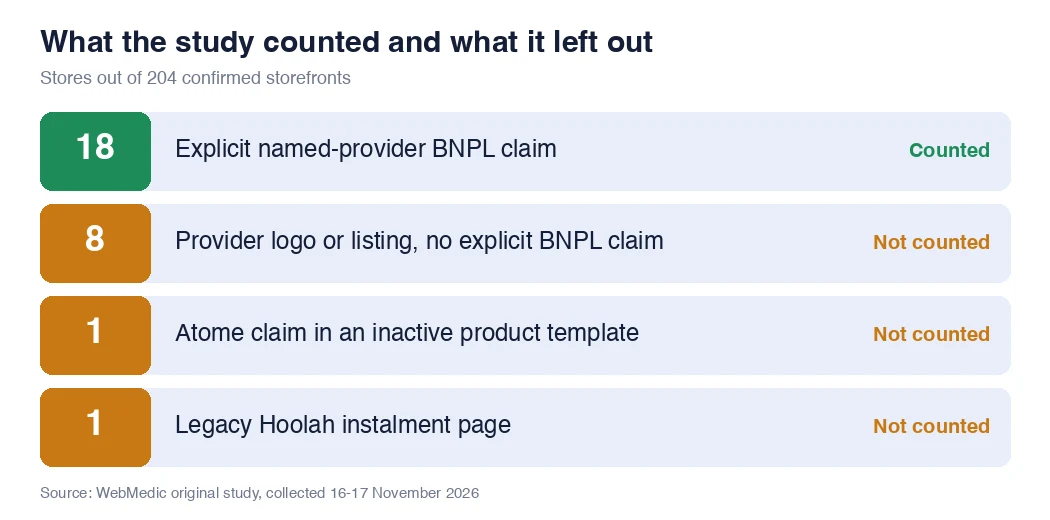
The inactive template. Carhartt WIP's Atome text sat in an inactive template on a sold-out product. It was absent from the browser-derived text, so we dropped it.
The legacy page. Nixtic still carried Hoolah copy. ShopBack told The Business Times that it was discontinuing its PayLater service in Malaysia on 22 March 2024. The article describes that service as introduced after ShopBack acquired Hoolah. A store still showing Hoolah instalments is showing a stale offer.
The unclear cases. Kutaye and Beooshop both advertised Klarna on USD storefronts. Their shared statement about operating in several countries left their eligibility for a Malaysian-market sample unresolved, so we did not count them.
Does this sound like your store? Find out where you are leaking revenue. Take the free Revenue Score. 3 minutes. Free. No pitch.
What Can This Study Not Tell You?
A lot. And we would rather say so here.
This is a convenience sample of 204 confirmed storefronts, enriched for top-ranked stores in listed locations, with 87 of 300 candidates unresolved. It cannot estimate Malaysian adoption, provider market share, real checkout availability or any effect on conversion.
Here is what is missing.
- Checkout is unknown. None of the 204 stores had a completed checkout-method verification. A store with no BNPL copy in the pages we checked may still offer it at checkout. No explicit claim found is not evidence that BNPL is unavailable.
- Rendering is unverified. We read server-delivered text. We did not confirm what a shopper sees on first paint, or whether a given product is eligible.
- Coverage is uneven. We checked one product per eligible store where possible. Help-page coverage varied between stores. Twenty-four stores had no readable ordinary product page.
- Merchant copy goes stale. A page can promise a provider the store no longer uses. Hoolah at Nixtic is the clean example.
- The unit is a hostname. Stores are not independently owned businesses. Two hostnames can share an owner.
- The frame is selective. Directory rankings and 65 failed directory reads shaped who got in.
We also did not measure conversion. If you have seen a conversion lift quoted next to this topic, it came from a provider or an agency, not from this study.
Our confidence in the page-copy classification is moderate, for the reasons above.
What Should a Shopify Store Owner Do With These Findings?
Check your own page first.
Compare your product page with the 9 of 180 readable product pages in this study that carried named-provider BNPL copy. Then test checkout yourself, because none of the 204 stores had a checkout verification. A page claim and an accepted payment method are separate checks.
The study is a mirror, not a recipe. Here is how to use it.
- Open a product page on your phone. Look for the provider's name and the instalment terms near the price. If a shopper has to reach checkout to learn that instalments exist, you have hidden your own offer.
- Run a test order through checkout. See which providers appear, in what order and for which basket values. Public page copy and checkout availability can differ.
- Match copy to reality. Remove retired providers. Hoolah copy at a store in 2026 is a trust risk. Anything that says "instalment" must match a method that actually completes.
- Name the provider. The stores in the count named Atome, Grab PayLater or SPayLater in text, in a logo or in a direct link. Generic "pay later" language was not enough for us to count it.
- Pair it with your gateway. BNPL sits beside cards, FPX and wallets. Our guide to the best Shopify payment gateways for Malaysia covers the base layer, and Shopify checkout friction points lists where shoppers drop out.
If you want a team to audit the page, the checkout and the messaging together, that is what our Shopify Malaysia work covers. Start with the scorecard above. It takes three minutes.
Frequently Asked Questions
How many Shopify stores in Malaysia offer BNPL?
Nobody can say for all of Malaysia. In WebMedic's sample of 204 confirmed Malaysian-market Shopify storefronts, 18 named a BNPL provider in checked public page copy. The sample is a convenience sample, and checkout availability was not verified, so the real figure could be higher or lower.
Which BNPL providers do Malaysian Shopify stores use?
In our sample of 204 confirmed storefronts, 13 explicitly named Atome, 8 named Grab PayLater and 4 named SPayLater. Five of the 18 stores with a claim named more than one provider. These are public copy counts, not provider market shares, and they say nothing about checkout.
Is BNPL shown on product pages or only at checkout?
Both exist, but we could only measure product pages. Nine of 180 readable ordinary product pages carried named-provider BNPL copy, and 9 of 204 stores had it on a checked help or FAQ page. None of the 204 stores had a verified checkout method, so checkout-only BNPL is unknown.
Does this study show that BNPL lifts conversion?
No. The study counted public BNPL claims on 204 storefronts and did not measure orders, conversion or revenue. Any conversion lift you read elsewhere is a provider or agency claim. Our BNPL conversion article lists those claims with their sources and warns that they are self-reported.
Keep Reading
Free Download
The payment + checkout leaks every Shopify store has (most never notice).
6 of the 15 leaks we find are payment-stage. BNPL placement, gateway choice, checkout friction.
From 10 Shopify audits across MY/SG. Markets with active BNPL adoption.
PDF in your inbox in 30 seconds. 1 email. No follow-up unless you ask.