Is your store leaking revenue?
Find out exactly where you're losing sales — takes 2 minutes.
The margin formula, crew model, and cadence that keep a live show profitable from show one
What Is TikTok Shop Live Selling?
Short answer: it is selling on camera, live.
TikTok Shop live selling is a hosted, real-time broadcast where products are demonstrated and sold directly through TikTok's in-app checkout while the stream is running. TikTok Shop's Southeast Asia GMV doubled year-on-year to $45.6 billion in 2025, with Malaysia named among the region's fastest-growing markets (TNGlobal, 2026, citing Momentum Works). It compresses discovery, demonstration, and checkout into one session.
A host shows the product. Viewers ask questions in the chat. Someone taps to buy before the excitement wears off.
That is the whole appeal. But most brands skip the one calculation that decides whether a show makes money or quietly bleeds it: the margin math.
We have audited enough Shopify stores testing live selling to see the same mistake twice: brands price for a normal sale, then get surprised when platform fees, payment processing, and host commission eat the difference. Fix the pricing first. Everything else in this guide builds on it.
How Much Should You Mark Up Products Before Going Live on TikTok Shop?
Get this wrong and every sale loses money.
A safe live-selling markup has to cover TikTok Shop's own take rate plus your team's cut before you keep a cent. In Malaysia, TikTok Shop's commission and transaction fees run roughly 12 to 14% combined for most categories, rising to about 19% if you are enrolled in the optional Bonus Cashback programme (Inseller, 2026). Add host or team compensation (commonly 10 to 15% of show revenue) and the total burden runs roughly 22 to 34%.
Here is the arithmetic, step by step:
- Add your TikTok Shop commission, transaction fee, and team compensation together. Call this your total burden percentage.
- Calculate your breakeven multiplier:
1 ÷ (1 − total burden %). - Multiply your product cost by that number to find your breakeven price.
- Add your own target margin on top. The breakeven number only gets you to zero.
| Cost | Typical Range | Source |
|---|---|---|
| TikTok Shop commission fee | 8-10% (category-dependent) | TikTok Shop Malaysia fee schedule |
| TikTok Shop transaction fee | 3.78% | TikTok Shop MY 2026 fee update |
| Optional Bonus Cashback programme fee | ~4.86% (capped near RM50/order) | TikTok Shop MY 2026 fee update |
| Host / team compensation | 10-15% of show revenue | Common live-selling compensation range |
| Total off-the-top burden | ~22-34% | Combined; higher end if enrolled in Bonus Cashback |
Rates are Malaysia's published Seller Centre schedule as of the 2026 update. Singapore's schedule differs, so check your own Seller Centre rate card before pricing a show.
Run the middle of that range (about 28%) and your breakeven multiplier is roughly 1.39. A product costing RM50 needs to sell for at least RM70 just to break even, before you have decided what profit you actually want.
One live-commerce operator, Battlebox, built its own version of this rule on Whatnot: a flat 52% markup, written as minimum selling price = product cost x 1.52. That number covers Whatnot's own fee stack (roughly 8% platform commission, 3% payment processing, and $0.30 per transaction, described by the source as about 11% combined), plus an 8.5% to 10% team commission burden. Whatnot's fees are not TikTok Shop's fees. Do not copy the 1.52 multiplier onto a TikTok Shop show.
What you should copy is the method, not the number: total your own commission, transaction fees, and host compensation, calculate your breakeven multiplier, then decide how much cushion you want on top. Worth noting: once you count an active Bonus Cashback enrollment plus team commission, TikTok Shop's own burden can land close to Battlebox's 1.52 Whatnot multiplier anyway, for entirely different fee reasons. That is a coincidence of arithmetic, not proof the same number applies to your category. Run your own inputs before you go live.
Round your starting bid or live-only price up slightly so the pricing logic is not obvious to the viewer.
What Is Revenue Per Hour, and Why Does It Matter More Than Total Sales?
Total revenue lies to you. Revenue per hour does not.
Revenue per hour is calculated as total show revenue divided by total selling hours, and live-selling operators treat it as the primary signal for whether a host, time slot, or format is working. There is no universal threshold. The right number depends entirely on your category, price point, and host cost, so you have to set your own floor from your own numbers.
Why per-hour instead of per-show? A three-hour show that made $300 looks fine until you compare it to a 45-minute show that made $250. The second host is nearly four times as efficient.
One operator playbook cites a single top-performing host who reportedly averaged around $4,000 in revenue per hour over a run of shows. Treat that as proof that strong host-audience fit shows up clearly in the data, not as a benchmark for your category. No one selling handmade candles should expect to hit a number set by a different vertical entirely.
Track revenue per hour by host, by day, by time slot, and by theme. Use it to answer four questions:
- Which host earns a bigger share of your selling hours next week?
- Which time slot deserves the prime schedule spot?
- Is a low number a host problem, a product problem, or a traffic problem?
- Are you ready to add hours, or still testing?

Who Do You Need on a TikTok Shop Live Selling Team?
Three roles. One control rule. That is the whole model.
A TikTok Shop live selling show needs three distinct roles: a host who presents and sells, a showrunner who owns pricing and auction controls, and a channel owner who owns strategy and scheduling. The canonical control rule is that the showrunner, not the host, owns the floor price, so no one improvises a below-margin discount live on camera.
| Role | Owns | Notes |
|---|---|---|
| Host | Presenting the product, keeping energy up, talking with chat, closing the sale | Does not need to be a polished presenter. Some sellers only show hands and the product |
| Showrunner | Product lineup, pricing sheet, cost, minimum selling price, starting bid, auction timing | Needs spreadsheet competence and calm decision-making, not camera presence |
| Channel owner | Strategy, scheduling weeks ahead, performance review, hiring decisions | Keeps the channel accountable as it scales |
The rule that actually protects your margin: the host may see the shared pricing sheet during a small pilot, but the host should never improvise a below-floor decision while presenting. That call belongs to the showrunner, off camera, before the show starts.
One person can cover two or three roles during your first month. That is normal. But keep the responsibilities separate on paper even when one person holds them, so accountability does not disappear the moment you add a second person to the team.

Should You Start With a Weekly Show or an Auction-Style Pilot?
Two proven cadences. Pick one and commit.
The two most common TikTok Shop live selling cadences are a once-weekly 45 to 60 minute show with three to five products, and a burst-test pilot of roughly 10 total selling hours across 2 to 3 hour shows in the first month. Brands starting out generally do better with the weekly model because consistency, not production polish, is what builds a returning audience.
The weekly show model. Same day, same time, every week. One host, three to five products, one clear live-only offer, 45 to 60 minutes. The principle behind it: an audience that knows you go live every Wednesday at 7pm can plan around it. An audience that does not know when to expect you will not show up.
The auction pilot model. Ten total selling hours in the first month, shows running 2 to 3 hours, roughly 25 products per selling hour, using only your existing team with commission for the extra work. Two weekly meetings run this cadence: a Monday planning session and a Friday retrospective.
If you are testing live selling for the first time, start with the weekly show. It is lower overhead, easier to staff, and matches the equipment and team you likely already have. Move toward the auction-pilot cadence only once you want to collect data across more variables (host, time, theme, auction length) faster than a single weekly slot allows.
Whichever cadence you choose, apply one rule to every show: every show needs a stated learning objective. If your team cannot say what a show is testing, the show is only activity, not a test.
What Equipment Do You Actually Need for TikTok Shop Live Selling?
You do not need a studio. You need a phone that works.
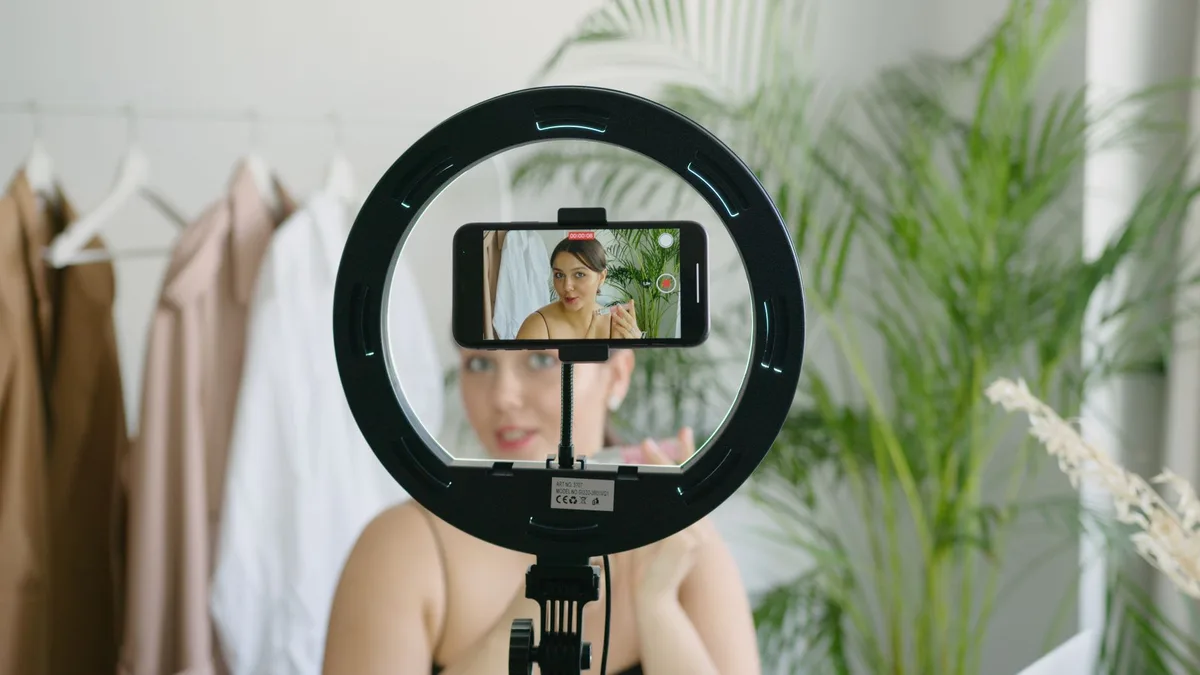
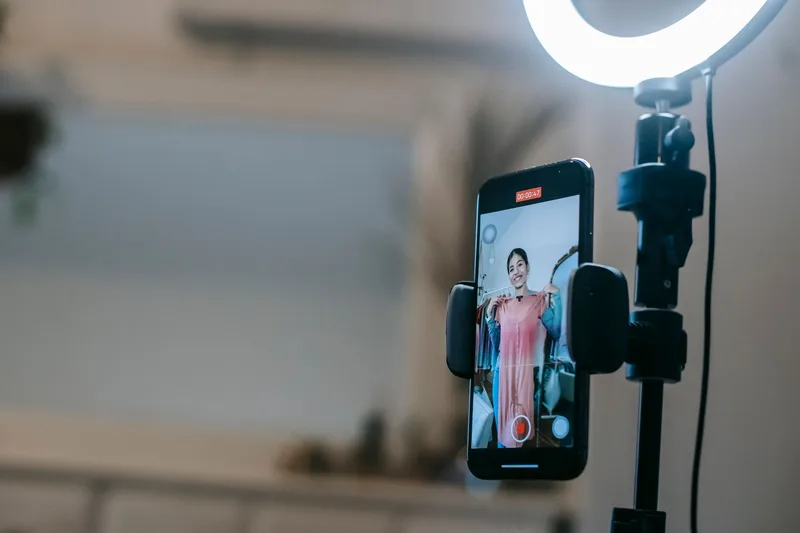
A bootstrap-stage TikTok Shop live selling setup costs under RM800 (roughly $150 to $190): a smartphone equivalent to an iPhone 12 or newer, a ring light, a simple tripod or phone mount, and a clip-on lapel microphone. Buying production equipment before proving the weekly show wastes money you have not earned yet.
The starter list:
- Smartphone, iPhone 12 or newer equivalent
- Ring light, roughly $40 to $100
- Tripod or phone mount
- Clip-on lapel microphone, roughly $25 to $65
- Stable internet connection, tested before showtime
Before every show, confirm camera, audio, lighting, internet, product catalogue, payment method, and analytics access are all working. A dead microphone five minutes into a live show cannot be fixed live.
Do not stream on multiple platforms at once while you are still proving the format on one. Do not compare your first month against a brand already doing five figures a month in live-selling revenue. That comparison is not useful yet.
Does this sound like your store? Find out where you're leaking revenue — take the free Revenue Score. 3 minutes. Free. No pitch.
How Do You Structure a TikTok Shop Live Selling Show to Convert?
The offer is not a mention. It is a repeated beat.
A converting TikTok Shop live selling show repeats its offer every 10 to 15 minutes, uses progressive buyer tiers such as bonuses for the first 10, 20, or 50 buyers, and closes with a deliberate 5-minute last-call period. Live shopping conversion rates are commonly cited in the 10% to 30% range, versus 2% to 3% for a standard product page. Treat that gap as upside you have to earn, not a guarantee.
Structure every show around five forces that a static product page cannot replicate: real-time social proof, urgency tied to the stream ending, trust built with a familiar host, entertainment value, and instant answers to objections.
Make the offer specific enough that the host can repeat it in one breath. "Use code LIVE for a discount" is vague. "The first 20 buyers get the bundle with free shipping, and it is gone when the stream ends" is not.
Build the show around three mechanics:
- Offer repetition. Restate the live-only offer every 10 to 15 minutes, not once at the start.
- Progressive tiers. Reward the first 10 buyers, then the first 20, then the first 50, so latecomers still have a reason to buy.
- The last call. Make the final five minutes of the show a deliberate close, with the deadline stated clearly and repeated.
Announce purchases as they happen. "Sarah just bought two, only three bundles left" does more for conversion than a static "127 people bought this" ever will, because it is happening in the room with the viewer, in real time.
When Should You Scale Your TikTok Shop Live Selling Program?
Do not hire before the number tells you to.
Live-selling operators typically use three revenue stages to decide when to add complexity: bootstrap (roughly under $12,000 a month), growth (roughly $12,000 to $60,000 a month), and scale (roughly $60,000-plus a month). Each stage has its own checklist, and the rule at every stage is the same: match your team and tooling to your current proof level, not to the brand you want to become.
| Stage | Revenue Band | What Changes |
|---|---|---|
| Bootstrap | Under ~$12,000/month | Prove the weekly habit. Existing team, starter equipment, one platform |
| Growth | ~$12,000 to $60,000/month | Add a chat-support role, test bundle offers, start clipping shows for other channels |
| Scale | ~$60,000+/month | Dedicated host, producer, and community manager. Show calendar tied to marketing calendar |
Bands are directional, converted from GBP live-selling operator benchmarks. Treat them as proportional stages, not fixed targets.
The bootstrap checklist has seven yes/no questions: fixed weekly show time, platform set up, working equipment, three to five products selected, one live-only offer, tracked metrics, and a scheduled next show. If your brand cannot hit at least five of those seven, do not add complexity yet. Fix the fundamentals first.
Move from bootstrap to growth when the show happens consistently, at least one offer has converted, the audience is asking questions, and a weekly review habit already exists. Move from growth to scale only when the host can no longer manage chat alone and the show is already feeding content into other channels. Upgrade because a real constraint has appeared, not because the show should look more professional.
Why Is TikTok Shop Live Selling Especially Strong in Malaysia and Singapore?
This is not an emerging trend here. It is already mainstream.
TikTok Shop live selling is structurally strong in Malaysia and Singapore because the platform already dominates regional social commerce. TikTok Shop's Southeast Asia GMV doubled to $45.6 billion in 2025, with Malaysia named among the fastest-growing markets in the region (TNGlobal, 2026). Shoppers in both markets are already comfortable buying inside the app, so the discovery-to-checkout gap most Western brands still have to close barely exists here.
Three things make a Malaysian or Singaporean live show different from a Western one:
- Bilingual hosting is standard. Hosts commonly switch between Malay and English, or English and Mandarin in Singapore, mid-sentence, matching whichever the chat is using.
- Prime-time slots are well established. Evening slots after work hours, particularly 8pm to 11pm, consistently draw the strongest concurrent viewer counts.
- Cash on delivery still shapes offer design. COD remains common in Malaysian ecommerce. Live-only bundles and progressive tiers need to work for COD buyers too, not only for those who pay in-app immediately.
If your brand already runs a Shopify store in Singapore, TikTok Shop live selling is one of the lower-friction ways to test a new sales channel without rebuilding your checkout stack. The audience and the payment habits are already in place.
Frequently Asked Questions
How does TikTok Shop live selling work?
TikTok Shop live selling is a hosted broadcast where a host demonstrates products and viewers buy directly through TikTok's built-in checkout without leaving the app. The show typically runs 45 minutes to 3 hours, with a host, a pricing sheet, and a live-only offer repeated throughout.
How much should I mark up products for TikTok Shop live selling?
Cover TikTok Shop's commission and transaction fees (roughly 12-14% combined in Malaysia, up to about 19% if enrolled in the optional Bonus Cashback programme), plus host or team compensation (typically 10-15% of revenue). That is roughly 22-34% in combined burden, giving a breakeven multiplier of about 1.28 to 1.52 before your target margin.
How many hours of live selling do I need before I know if it works?
Most live-selling playbooks recommend a 10-hour test in the first month, spread across 2 to 3 hour shows, using your existing team. Track revenue per hour, margin, and viewer engagement across at least two hosts and two time slots before deciding whether to scale.
Do I need a professional studio to start TikTok Shop live selling?
No. A bootstrap setup costs under roughly $150 to $190: a smartphone equivalent to an iPhone 12 or newer, a ring light, a tripod, and a clip-on lapel microphone. Production equipment is a growth-stage upgrade, not a starting requirement.
When should I hire dedicated staff for TikTok Shop live selling?
Hire when revenue per hour already justifies the extra selling capacity and the same person covering multiple roles has become the bottleneck. Do not hire to compensate for an unclear format. Prove the weekly show first, then hire against the specific constraint the data shows you.
Keep Reading

Free Download
We audited 10 Shopify stores doing $1M–$20M. Here are the 15 leaks every one had.
Real screenshots (names blurred). Most operators have 8 of the 15 and don't know it.
From 10 audits across SG, MY, AE — fashion, beauty, electronics, food.
PDF in your inbox in 30 seconds. 1 email. No follow-up unless you ask.