Is your store leaking revenue?
Find out exactly where you're losing sales — takes 2 minutes.
Run a two-minute test, pick one of two routes, then explain it in 3 to 5 steps
What Is a Unique Mechanism in Ecommerce?
Your product is not the point.
A unique mechanism is the proprietary process, system or method that delivers a customer's result in a new, easier, faster or more effective way than similar products. The Ecommerce Unique Mechanism System framework puts it in one line: a unique mechanism is not what you sell. It is how you deliver the result.
That line separates two things most stores blur. The promise is the transformation the customer wants. The mechanism is the process that gets them there.
Most product pages are all promise. "Clearer skin." "More energy." "Whiter teeth." The customer has read each of those lines a hundred times.
The framework gives a blunt example of a promise-style claim: "this will increase your testosterone by 2x in 120 days." It is a bigger number, and it is still only a result claim. Making the claim stronger does not make it a mechanism.
| Promise | Mechanism | |
|---|---|---|
| Answers | What will I get? | How does it get me there? |
| Sounds like | "Increase X by 2x in 120 days" | A named process, system, bundle or component |
| Copyable by a rival? | Yes, with one edit | Only if they build the same thing |
| Lives in | The headline | The explanation behind the headline |
Source: definitions from the Ecommerce Unique Mechanism System framework. The "promise-style claim" label is our reading of its example.
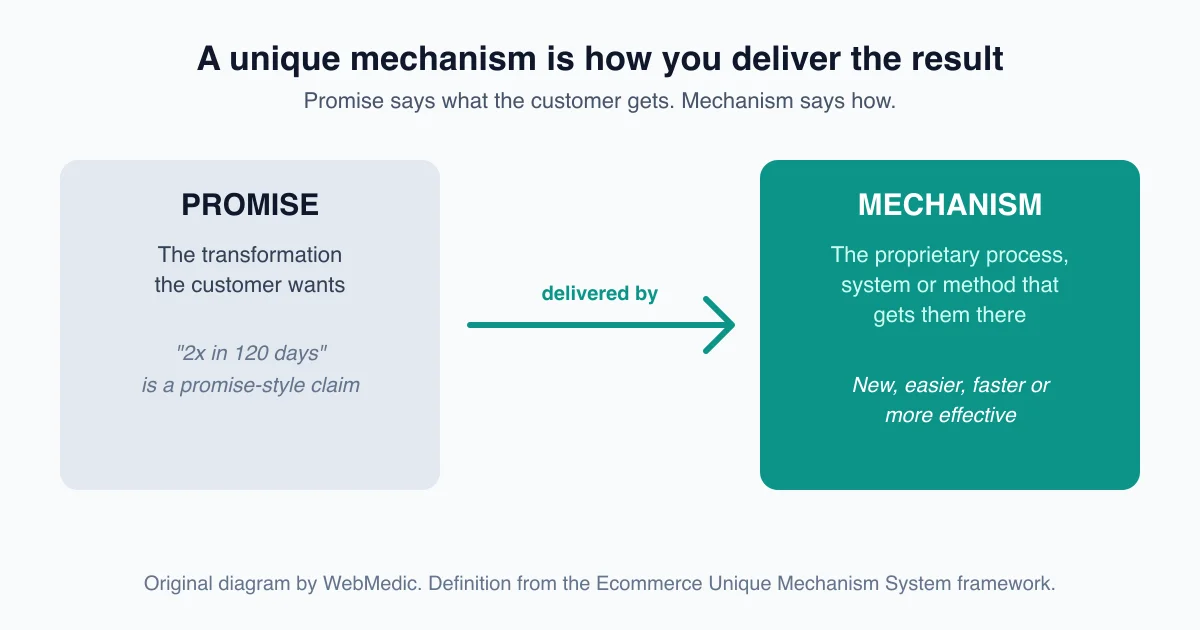
Rivals can match your price, your photos and your claim in a week. They cannot easily match a way of delivering the result that is built into your offer.
Where this post sits: positioning work, such as your value proposition, your positioning statement and the problems your brand addresses, says who you are for and why you matter. Offer work, such as the irresistible ecommerce offer, says what the customer gets. A unique mechanism is the how-it-works story between them that makes both believable.
First, check whether you need one at all.
How Do You Know If Your Store Needs a Unique Mechanism?
Look at the ads.
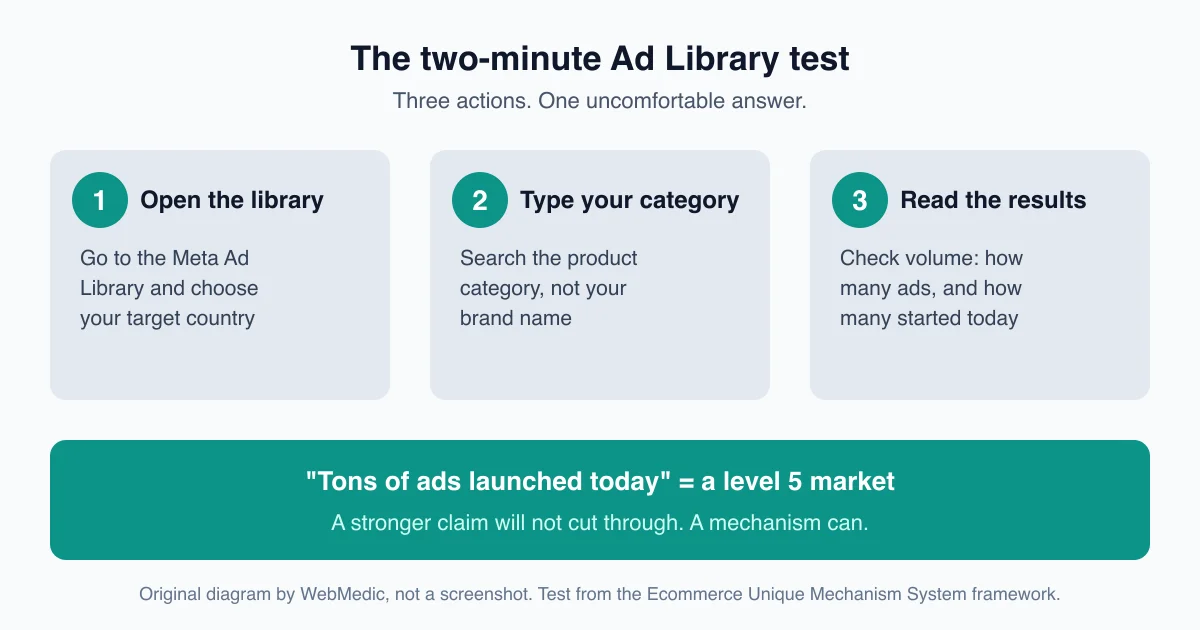
Open the Meta Ad Library, search your product category and read the volume and freshness of the ads. If you see tons of ads launched today, the Ecommerce Unique Mechanism System calls it a level 5 market, the most saturated stage. Meta says anyone can search the library, which holds all active ads across its technologies.
The test takes about two minutes. The framework describes it in three actions.
- Open the Meta Ad Library and pick the country you sell into.
- Type your product category. Use the category, not your brand name.
- Look at how many ads are running and how many started recently.
Meta's Business Help Center says the library contains all active ads shown across Meta technologies, and that anyone can view it and search any term. Active means competitors are paying for those ads right now. A wall of ads that began this week is a fresh, crowded field.
What does a level 5 market do to your ads?
In a level 5 market, buyers have already seen every claim and every product a hundred times, according to the framework. That is the key idea. They are not ignoring you because your ad is weak. They are ignoring you because it sounds like the last ten ads.
Add one more question. Could someone describe your offer as "the same product plus a better result claim"? If yes, and the library is crowded, build a mechanism. If the library is quiet, a clear offer and good basics may be enough. Our guide to the components of an irresistible ecommerce offer covers that case.
One honest limit. This test is a screen, not a proof. The framework gives it as a rule of thumb from a single practitioner, not as a measured study. It tells you where to look harder, nothing more.
Does this sound like your category? Before you rebuild your offer, find out where your store is leaking revenue today. Take the free Revenue Score. 3 minutes. Free. No pitch.
How Does the Bundle, Repackage and Rename Route Work?
This is the route most brands will use.
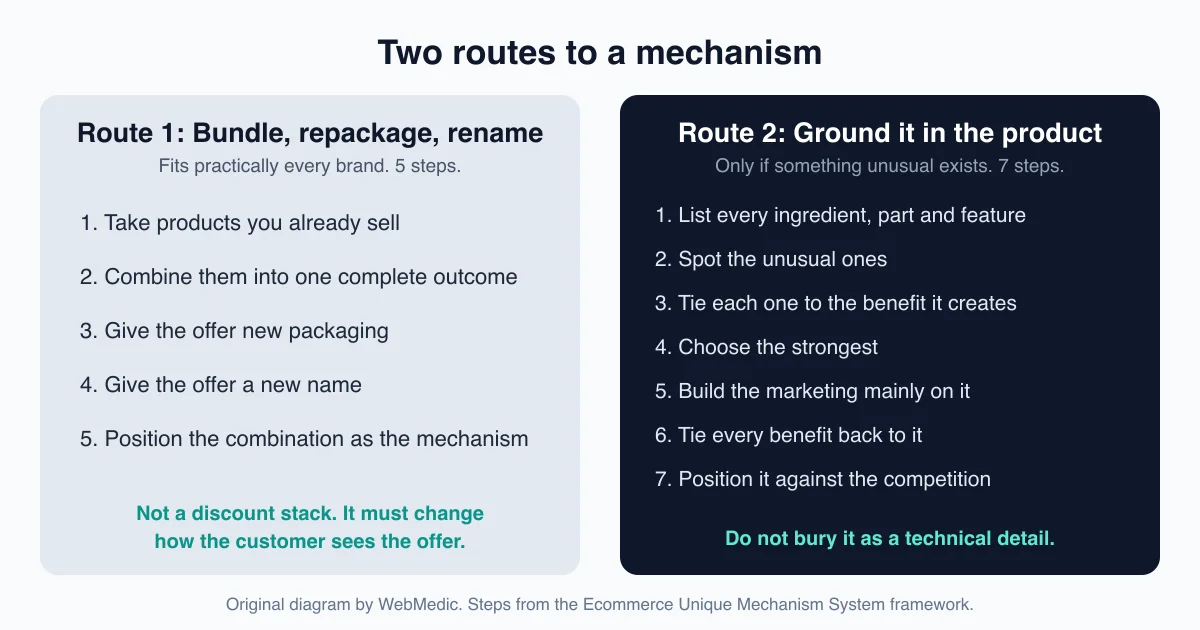
Bundle, repackage and rename is a five-step route: take products you already sell, combine them into one complete offer, give it new packaging, give it a new name, and position the combination itself as the mechanism. The Ecommerce Unique Mechanism System says most brands will use it because it applies to practically every brand.
You do not need a lab or a new product. You need products you already sell.
The framework sets a standard here. A bundle "should not be treated as a simple discount stack." It has to change how the customer sees the offer.
What does a real bundle mechanism look like?
The framework's worked example is a testosterone supplement that could not scale on ads. The US testosterone market, it says, is one of the most competitive there is, with thousands of competitors running the same product.
The fix was not a new formula. The brand combined the supplement with a pre-workout and an ebook. Then it renamed the whole offer as "a 30-day challenge to get in shape, get leaner, get stronger and increase your testosterone."
The offer now solves a larger problem than "raise testosterone." The combination became the mechanism, so the product alone was no longer the thing compared with rivals. The source notes the bundle lifted average order value. Treat that as a side effect. The goal is a different frame.
What must you explain about a bundle?
Two things, every time.
- Why one product alone is not enough to get the result.
- Why the combined offer solves the problem better than competing single-product offers.
If you cannot answer both, you have a discount stack, and a discount stack is not a mechanism. Shopify's guide to price bundling describes bundling as offering related products for an enticing price. A mechanism bundle is a different job: the new frame, name and explanation matter more than the discount.
How Do You Build a Unique Mechanism From Your Own Product?
Only if something unusual exists.
Route two grounds the mechanism in your technology or ingredients through seven steps: list every ingredient, component and feature, find the unusual ones, tie each to a benefit, choose the strongest, build marketing mainly on it, tie every benefit back to it, and position it against competitors. The Ecommerce Unique Mechanism System says it does not apply to everyone.
Step three does the work: an unusual element only counts once it is tied to a specific benefit.
Do not make your own products? Ask the manufacturer. The framework says to ask what is unusual about how the product is built, what it contains and how it works.
What does the oral care example show?
The framework's example is an oral care device that cleans with "ultrasonic micropulsation and precision air-water infusion."
Notice what happens next. Every benefit gets tied back to the mechanism:
"the micropulsation is why it's tough on plaque while staying gentle on gums, the slim design is why it reaches the tight spaces regular flossers can't."
Then comes the contrast: "unlike noisy, splashy water flossers."
The mechanism explains the benefits. The benefits do not stand alone.
The failure mode is just as clear. Do not bury the mechanism as a technical detail on a specs tab. If it is the strongest unusual element, the whole page is built around it.
Which Route Should You Pick: Bundle or Product?
Start with the bundle.
Pick the bundle route unless your product has a genuinely unusual ingredient, component or build. The Ecommerce Unique Mechanism System says the bundle version applies to practically every brand, while the product route works only when something unique already exists inside the product. Five steps for the bundle, seven for the product route.
Use this table to decide.
| Question | Bundle route | Product route |
|---|---|---|
| Steps | 5 | 7 |
| Needs a new product? | No, uses what you sell | No, but needs something unusual inside it |
| Applies to | Practically every brand | Brands with a distinctive ingredient, part or build |
| Where the mechanism lives | In the combination and its name | In the ingredient, technology or feature |
| Main risk | A plain discount stack | Burying it as a technical detail |
Source: Ecommerce Unique Mechanism System framework, routes one and two.
If you inspect every component and find nothing unusual, go to the bundle route. Do not invent a "proprietary" feature. Your page will have to explain it, and an invented one will not survive the explanation.
That brings us to the step most stores skip.
How Do You Explain a Unique Mechanism in 3 to 5 Steps?
Break it into a chain.
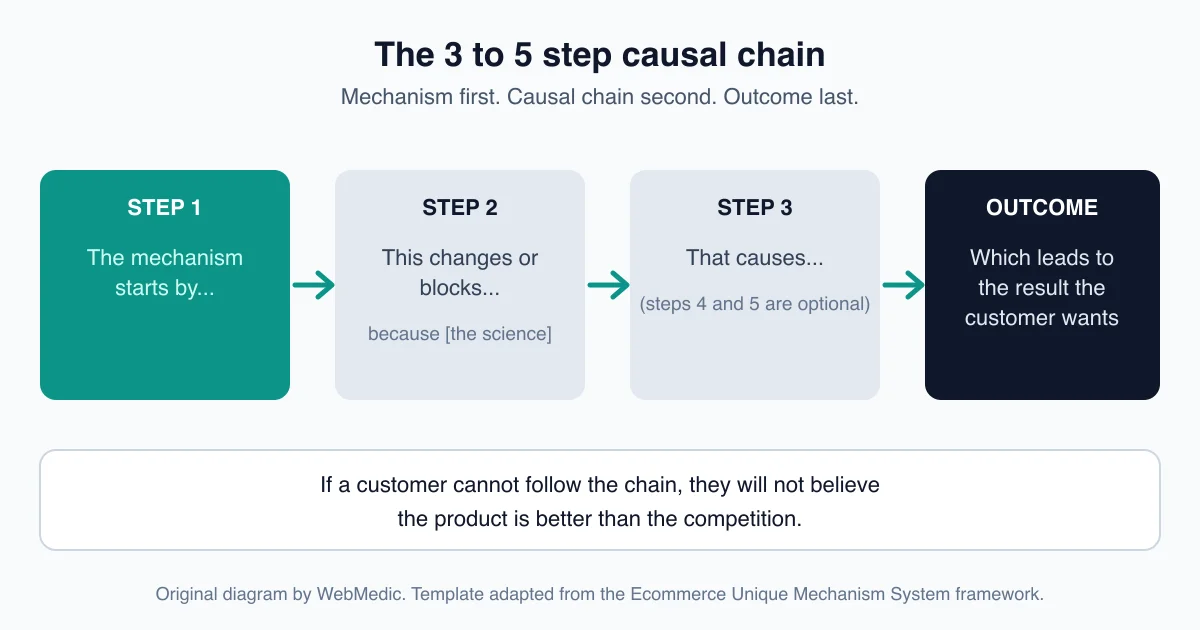
Break the mechanism into 3 to 5 logical steps that show how it produces the promised result. The Ecommerce Unique Mechanism System warns that if customers cannot follow the chain, they will struggle to believe the product beats the competition, and you lose the advantage the mechanism was meant to give.
A name is not an explanation. "Our proprietary system" tells the customer nothing. They need to follow how it works, one cause at a time.
The framework prints this template, built from a weight loss supplement example:
"The [unique ingredients] block the body's natural process of storing fat by [the literal science behind it] → the metabolism shifts to burning fat & carbs instead because [the science behind it] → your metabolic function & caloric burn rate go up → which leads to [the desired outcome]."
Mechanism first. Causal chain second. Outcome last.
Two cautions. The "literal science" has to be true, and health claims fall under advertising rules, so check your platform's policies and your local regulator. And WebMedic has not run a controlled test of mechanism pages. The examples here are the framework's, from one presenter, so treat them as worked examples, not benchmarks.
How Do You Use a Unique Mechanism in Ads and on a Pre-Sell Page?
Ads tease. Pages explain.
Use ads to tease the mechanism and create curiosity, and use a pre-sell page to explain, differentiate and prove it in an eight-step sequence before the product page. The Ecommerce Unique Mechanism System warns that a brand that sends traffic straight to a product page will have a hard time scaling in general.
How should an ad handle the mechanism?
Do not explain everything in the ad. Tease it to create curiosity, and name what the audience is skeptical about: hint at a different cause, then rule out the old explanations the buyer already distrusts.
The framework says correct execution takes testing. Our post on how many ads to launch each week covers the testing cadence.
What goes on the pre-sell page?
The pre-sell page is where you position against competitors and teach why the mechanism works. The framework gives an eight-step order.
- Walk through the solutions the audience has already tried.
- Present them neutrally, so it is not obvious the page is selling.
- Explain logically why each one does not work.
- Help the reader understand their problem.
- Introduce the mechanism as fundamentally different.
- Educate them on how and why it works, using the 3 to 5 step chain.
- Show as much proof as possible to kill remaining skepticism.
- Send them to the product page to buy.
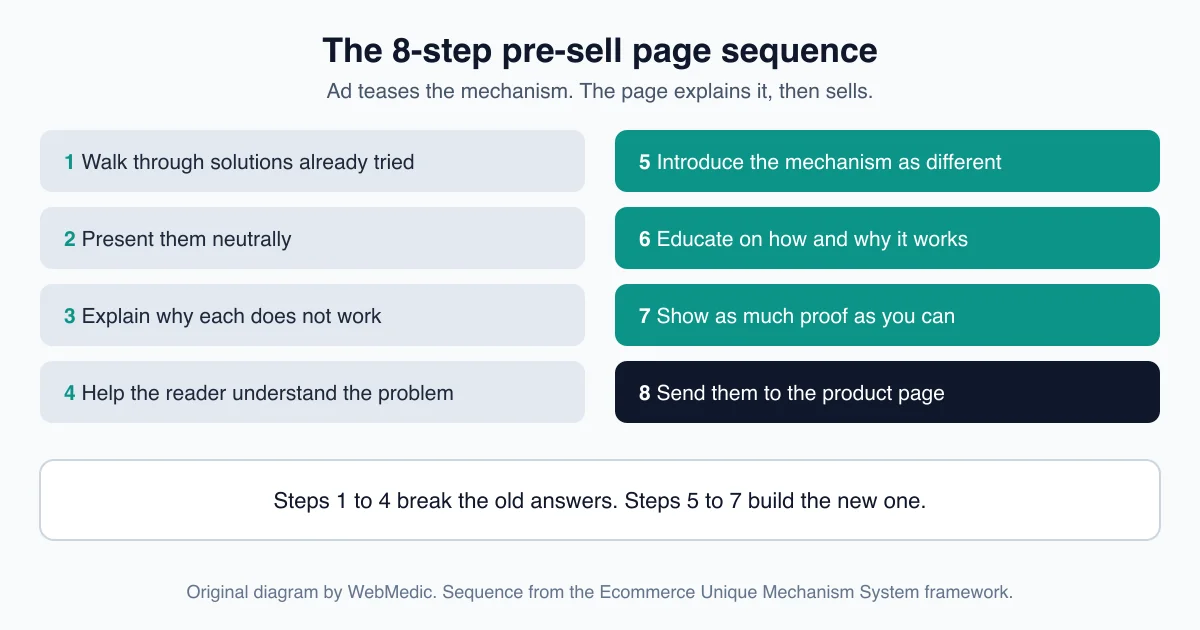
The framework also allows a hybrid page where the offer and price appear on the same page, as long as the offer comes after the positioning and education.
The order is the point. The old answers are broken first. The mechanism arrives only after the reader feels the problem. Put the offer at the top and you lose the build-up.
Two of our posts help here. Step 7 needs proof, and showing product flaws is one way to make proof believable. A page like this runs long, and long copy is not the problem when every section earns its place. To check an existing page first, compare its flow with our landing page optimization framework.
What Does a Mechanism Look Like for a Malaysian or Singapore Skincare Brand?
Start with the saturation check.
In Malaysia and Singapore, skincare and supplement categories are often crowded on TikTok Shop and Shopee, where listings repeat the same claims. Build the mechanism by bundling products you already sell into a named routine, then tie one unusual ingredient or feature to a benefit and explain it in 3 to 5 steps.
The example below is a hypothetical brand we made up to show the method. It is not a client story and it is not a benchmark.
Picture a local brand that sells a gel moisturiser, a gentle cleanser and a sunscreen. Search the category on Shopee and TikTok Shop, then open the Meta Ad Library and set the country to Malaysia or Singapore. If page after page shows "brighter, hydrated, glowing skin" with a different logo, you are in the crowded field the framework describes.
Step 1: choose the route. The brand has no unusual ingredient yet, so it takes the bundle route. It packages the three products as one routine and renames it "The Humid-Weather Skin Routine." The new name frames the problem as skin under heat, sweat and air-conditioning, not "dull skin."
Step 2: answer the two bundle questions. Why is one product alone not enough? A moisturiser does not protect skin outdoors, and a sunscreen does not restore moisture after cleansing. Why is the routine better than single-product listings? It covers cleansing, moisture and sun protection in one sequence.
Step 3: add route two if something is unusual. Ask the manufacturer what the formula contains and how it works. If one ingredient or texture is truly unusual and the maker can document it, tie it to a benefit. Do not invent one.
Step 4: write the chain. For example: the lightweight gel holds moisture without heavy layers in humid weather → skin feels comfortable without a greasy film → the routine is easier to keep up daily → which leads to the outcome the customer wants. Only make claims your formulation data supports.
Step 5: put the explanation on a pre-sell page. Marketplace listings are thin on space. Send ad traffic to a page that follows the eight-step sequence, then to checkout.
Check rules before launch. Cosmetics and health supplements are regulated, so confirm claims with the National Pharmaceutical Regulatory Agency (NPRA) in Malaysia or the Health Sciences Authority (HSA) in Singapore, plus each platform's policy.
What Mistakes Make a Unique Mechanism Fail?
Most failures are quiet.
Four mistakes sink most mechanisms: a discount stack passed off as a bundle, a mechanism buried as a technical detail, no 3 to 5 step explanation, and ad traffic sent straight to a product page. Each one breaks a rule in the Ecommerce Unique Mechanism System, which prescribes a pre-sell page before the product page.
A fifth is worse: a mechanism that is not true. If it fails when a skeptical buyer checks it, the proof step collapses.
For the positioning side, read our notes on the three levels of problems your store should address. If traffic is scaling and the page still does not convert, the WebMedic Scale path is built for that.
Frequently Asked Questions
What is a unique mechanism in ecommerce?
It is the proprietary process, system or method that delivers a customer's result in a new, easier, faster or more effective way than similar products. The promise is the transformation. The mechanism is the route to it.
How do I know if I need a unique mechanism?
Search your product category in the Meta Ad Library and check the volume and freshness of ads. Tons of ads launched today means level 5, the most saturated stage, where a stronger claim will not cut through.
Can I create a unique mechanism without a new product?
Yes. The bundle, repackage and rename route uses products you already sell: combine them into one complete offer, repackage and rename it, and position the combination as the mechanism.
How many steps should a mechanism explanation have?
Between 3 and 5 logical steps, each showing how the mechanism leads to the promised result. If customers cannot follow the chain, they struggle to believe your product beats the competition.
Do I need a pre-sell page for a unique mechanism?
Yes, if you want it to scale. The framework says a brand that sends traffic straight to a product page will have a hard time scaling in general.
Keep Reading

Free Download
We audited 10 Shopify stores doing $1M–$20M. Here are the 15 leaks every one had.
Real screenshots (names blurred). Most operators have 8 of the 15 and don't know it.
From 10 audits across SG, MY, AE — fashion, beauty, electronics, food.
PDF in your inbox in 30 seconds. 1 email. No follow-up unless you ask.